


Dusky Munia
Lonchura fuscans
- KingdomAnimalia (Animals)
- PhylumChordata (Chordates)
- ClassAves (Birds)
- OrderPasseriformes (Perching Birds)
- FamilyEstrildidae (Waxbills and Allies)
- GenusLonchura (Typical Munias and Mannikins)
- SpeciesLonchura fuscans (Dusky Munia)
About the Dusky Munia
The dusky munia (Lonchura fuscans) is a species in the estrildid finch Family and is endemic to Borneo. It is also commonly referred to as the Dusky mannikin and the Bornean munia. It is in the genus Lonchura and is a monotypic species, so there are no subspecies.
The status of the species is evaluated as Least Concern. It is most commonly spotted on the Island Borneo, but can be found in Brunei, Indonesia, Malaysia, and the Philippines. It is also an introduced species in Natuna, Banggi, Cagayan and Sulu Islands. While the population size of the species is unknown, the population growth is stable, and virtually unthreatened. It is found in subtropical/ tropical lowland shrubland, forest and grassland habitat. Its habitat can vary widely, with sightings being recorded in the foothills of the island Borneo, grasslands, and agricultural fields such as rice paddy fields. They also tend to reside along riverbanks, reed-beds, secondary scrub and cultivated areas, from sea-level all the way up to 500 meters above ground. They are not migrants, and do not venture outside of their habitat during seasonal changes like many other species of birds. Wikipedia →
Closest Relatives at Tanjung Puting National Park

Chestnut Munia
Lonchura atricapilla

Malaysian Pied-Fantail
Rhipidura javanica

Black-and-red Broadbill
Cymbirhynchus macrorhynchos

Olive-winged Bulbul
Pycnonotus plumosus
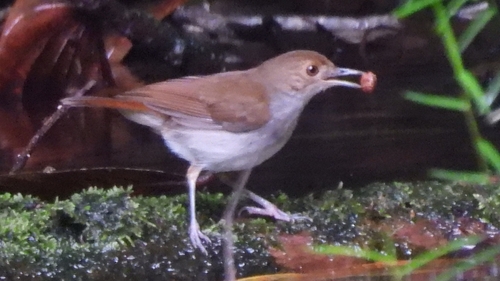
White-chested Babbler
Trichastoma rostratum

Little Spiderhunter
Arachnothera longirostra

Slender-billed Crow
Corvus enca

Van Hasselt's Sunbird
Leptocoma brasiliana

Malaysian Blue-Flycatcher
Cyornis turcosus

Greater Racket-tailed Drongo
Dicrurus paradiseus

Black-winged Flycatcher-shrike
Hemipus hirundinaceus

Green Iora
Aegithina viridissima
Global Distribution
Where this species is recorded worldwide. Restricted to human observations from 2019 onwards — the same kind of record and the same period the probabilities on this page are built from, so collar-tracking studies, camera-trap arrays and museum specimens are excluded. Around Santa Rosa that removes 5,924 GPS fixes from a handful of tagged jaguars.
where this species is recorded (GBIF density — it tracks where observers go, not how likely a sighting is) · parks where it occurs — tap a pin for the sighting probability there
Parks Where Found
| # | Park | Country | Daily sighting probability |
|---|---|---|---|
| 1 | Danum Valley Conservation Area | 🇲🇾 Malaysia | |
| 2 | Bako National Park | 🇲🇾 Malaysia | |
| 3 | Sepilok | 🇲🇾 Malaysia | |
| 4 | Kinabatangan Wildlife Sanctuary | 🇲🇾 Malaysia | |
| 5 | Tanjung Puting National Park | 🇮🇩 Indonesia | |
| 6 | Kinabalu Park | 🇲🇾 Malaysia |
Quick answers
What are the chances of seeing a Dusky Munia in Tanjung Puting National Park?
About 10% of wildlife watchers report a Dusky Munia sighting in Tanjung Puting National Park, based on 8 verified sightings from GBIF citizen-science data.
When is the best time to see Dusky Munia in Tanjung Puting National Park?
October has the highest sighting rate for Dusky Munia in Tanjung Puting National Park in our monthly data.