


Scarlet-headed Flowerpecker
Dicaeum trochileum
- KingdomAnimalia (Animals)
- PhylumChordata (Chordates)
- ClassAves (Birds)
- OrderPasseriformes (Perching Birds)
- FamilyDicaeidae (Flowerpeckers)
- GenusDicaeum (Typical Flowerpeckers)
- SpeciesDicaeum trochileum (Scarlet-headed Flowerpecker)
About the Scarlet-headed Flowerpecker
The scarlet-headed flowerpecker (Dicaeum trochileum) is a bird species in the family of Dicaeidae. It is a species endemic to Indonesia. This flowerpecker inhabits a few islands of the archipelago of Indonesia. It is mainly observed in open wooden areas, gardens, and mangroves.
As of today, D. trochileum population is stable. The IUCN has classified its conservation status to Least Concern. This species is not well studied. The scarlet-headed flowerpecker body length can reach up to eight to nine centimeters after maturity.
The red to orange upper body of the males is the main characteristic that distinguishes them from the females. Their red plumage covers their head, their back, their rump and their throat. Their wings are black with blue pigmentation. Their legs are black, and their beak is grey. The tip of their tail is black.
The females have a light grey to brown head and back. Their orange to red rumps characterize the females' morphology. Similarly to the males, their legs are black, their beak is grey, and the tip of their tail is black. Their wings are lighter than the male's wings colour, and they are missing the blue coloration.
The morphology of the juveniles... Wikipedia →
Closest Relatives at Tanjung Puting National Park

Orange-bellied Flowerpecker
Dicaeum trigonostigma

Scarlet-backed Flowerpecker
Dicaeum cruentatum

Plain Flowerpecker
Dicaeum minullum

Crimson-breasted Flowerpecker
Prionochilus percussus

Yellow-breasted Flowerpecker
Prionochilus maculatus

Scarlet-breasted Flowerpecker
Prionochilus thoracicus

Yellow-rumped Flowerpecker
Prionochilus xanthopygius

Malaysian Pied-Fantail
Rhipidura javanica

Black-and-red Broadbill
Cymbirhynchus macrorhynchos

Olive-winged Bulbul
Pycnonotus plumosus
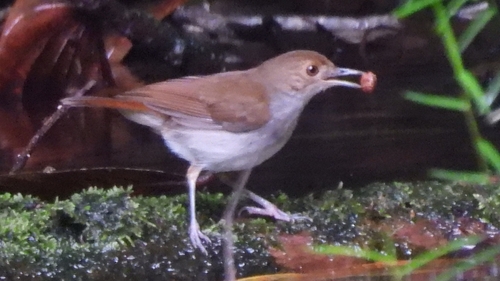
White-chested Babbler
Trichastoma rostratum

Little Spiderhunter
Arachnothera longirostra
Global Distribution
Where this species is recorded worldwide. Restricted to human observations from 2019 onwards — the same kind of record and the same period the probabilities on this page are built from, so collar-tracking studies, camera-trap arrays and museum specimens are excluded. Around Santa Rosa that removes 5,924 GPS fixes from a handful of tagged jaguars.
where this species is recorded (GBIF density — it tracks where observers go, not how likely a sighting is) · parks where it occurs — tap a pin for the sighting probability there
Parks Where Found
| # | Park | Country | Daily sighting probability |
|---|---|---|---|
| 1 | Bali Barat National Park | 🇮🇩 Indonesia | |
| 2 | Way Kambas National Park | 🇮🇩 Indonesia | |
| 3 | Tanjung Puting National Park | 🇮🇩 Indonesia |