



Colombian Red Howler Monkey
Alouatta seniculus
Silhouette: PhyloPic · PhyloPic
- KingdomAnimalia (Animals)
- PhylumChordata (Chordates)
- ClassMammalia (Mammals)
- OrderPrimates
- FamilyAtelidae (Spider, Howler, and Woolly Monkeys)
- GenusAlouatta (Howler Monkeys)
- SpeciesAlouatta seniculus (Colombian Red Howler Monkey)
About the Colombian Red Howler Monkey
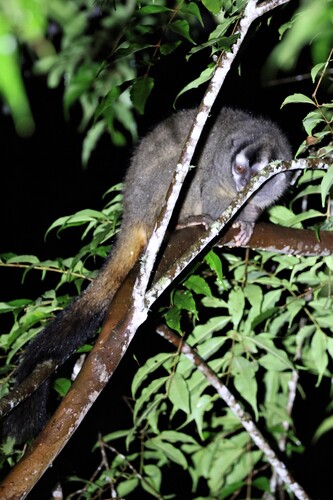
The Colombian red howler or Venezuelan red howler (Alouatta seniculus) is a South American species of howler monkey, a type of New World monkey, found in the western Amazon Basin in Venezuela, Colombia, Ecuador, Peru and Brazil. The population in the Santa Cruz Department in Bolivia was split off as a separate species, the Bolivian red howler, in 1986, and more recently, splitting off the population in northeastern South America and Trinidad as the Guyanan red howler has occurred. All howler monkeys belong to the family Atelidae and the infraorder Platyrrhini (New World monkeys).
Sexual dimorphism in this species is small; males range from 49 to 72 cm and females from 46 to 57 cm long. The males weigh 5.4–9 kg, while females weigh 4.2–7 kg. It has a long prehensile tail of 49–75 cm. The tail is covered with fur except for the last third of the underside, which allows it to grab branches. The color of both males and females is a deep reddish-brown, and the color shade changes with age. Their faces are surrounded by fur and they have stubby noses.
The jawbone of the red howler monkey is large, especially the body of the mandible. The position of the foramen magnum... Wikipedia →
Recent sightings of Colombian Red Howler Monkey in Tayrona National Natural Park
LIVEiNaturalistClosest Relatives at Tayrona National Natural Park



Global Distribution
Warmer areas are where this animal is recorded most often.
Parks Where Found
| # | Park | Country | Daily sighting probability |
|---|---|---|---|
| 1 | Tayrona National Natural Park | 🇨🇴 Colombia | |
| 2 | Cuyabeno Wildlife Reserve | 🇪🇨 Ecuador | |
| 3 | Yasuní National Park | 🇪🇨 Ecuador | |
| 4 | Sierra de la Macarena National Park | 🇨🇴 Colombia | |
| 5 | Amacayacu National Natural Park | 🇨🇴 Colombia | |
| 6 | Tambopata National Reserve | 🇵🇪 Peru | |
| 7 | Manu National Park | 🇵🇪 Peru | |
| 8 | Los Nevados National Natural Park | 🇨🇴 Colombia | |
| 9 | Anavilhanas National Park | 🇧🇷 Brazil | |
| 10 | Cordillera Azul National Park | 🇵🇪 Peru |
Quick answers
What are the chances of seeing a Colombian Red Howler Monkey in Tayrona National Natural Park?
About 70% of wildlife watchers report a Colombian Red Howler Monkey sighting in Tayrona National Natural Park, based on 108 verified sightings from GBIF citizen-science data.
When is the best time to see Colombian Red Howler Monkey in Tayrona National Natural Park?
March has the highest sighting rate for Colombian Red Howler Monkey in Tayrona National Natural Park in our monthly data.