



Red-shouldered Macaw
Diopsittaca nobilis
Silhouette: Sheatherius · PhyloPic
- KingdomAnimalia (Animals)
- PhylumChordata (Chordates)
- ClassAves (Birds)
- OrderPsittaciformes (Parrots)
- FamilyPsittacidae (New World and African Parrots)
- GenusDiopsittaca
- SpeciesDiopsittaca nobilis (Red-shouldered Macaw)
About the Red-shouldered Macaw
The red-shouldered macaw (Diopsittaca nobilis) is a small green South American parrot, a member of a large group of Neotropical parrots called macaws. The species is named for the red coverts on its wings. It is the smallest macaw, being 30 cm (12 in) in length – similar in size to the Aratinga parakeets. It is native to the tropical lowlands, savannahs, and swamplands of Brazil, the Guianas, Bolivia, Venezuela, and far south-eastern Peru. There are three subspecies: The noble macaw (Diopsittaca nobilis cumanensis), Hahn's macaw (Diopsittaca nobilis nobilis), and the long-winged macaw (Diopsittaca nobilis longipennis). The long-winged macaw is a poorly distinct third subspecies that has longer wings, but is otherwise similar to the noble macaw. The Hahn's subspecies is named for German zoologist Carl-Wilhelm Hahn, who in 1834 began compiling Ornithologischer Atlas oder naturgetreue Abbildung und Beschreibung der aussereuropäischen Vögel (Engl: Ornithological Atlas or natural depiction and description of birds from outside Europe).
Red-shouldered macaws are frequently bred in captivity for the pet trade, where they are sometimes described as mini-macaws. Though wild populations of red-shouldered macaws have declined locally due to habitat loss, they are listed as Least Concern by IUCN. They are listed on Appendix II of CITES, and trade is restricted. Wikipedia →
Recent sightings of Red-shouldered Macaw in Tijuca National Park
LIVEiNaturalistClosest Relatives at Tijuca National Park

 Plain Parakeet
Brotogeris tirica

 Maroon-bellied Parakeet
Pyrrhura frontalis

 White-eyed Parakeet
Aratinga leucophthalma

Scaly-headed Parrot
Pionus maximiliani
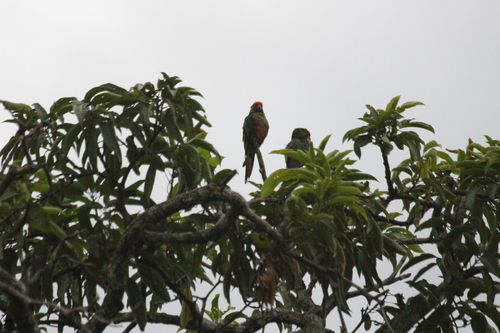
Golden-capped Parakeet
Aratinga auricapillus
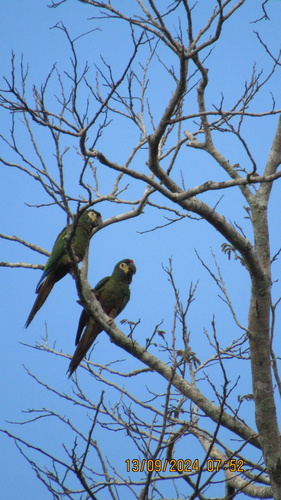
Blue-winged Macaw
Primolius maracana

Monk Parakeet
Myiopsitta monachus

Scarlet-fronted Parakeet
Aratinga wagleri

Brown-backed Parrotlet
Touit melanonotus

 Blue-fronted Parrot
Amazona aestiva

Yellow-chevroned Parakeet
Brotogeris chiriri

Peach-fronted Parakeet
Aratinga aurea
Global Distribution
Warmer areas are where this animal is recorded most often.
Parks Where Found
| # | Park | Country | Daily sighting probability |
|---|---|---|---|
| 1 | Emas National Park | 🇧🇷 Brazil | |
| 2 | Chapada dos Guimarães National Park | 🇧🇷 Brazil | |
| 3 | Tijuca National Park | 🇧🇷 Brazil | |
| 4 | Canaima National Park | 🇻🇪 Venezuela | |
| 5 | Madidi National Park | 🇧🇴 Bolivia | |
| 6 | Tambopata National Reserve | 🇵🇪 Peru | |
| 7 | Parque Estadual Encontro das Águas | 🇧🇷 Brazil | |
| 8 | Noel Kempff Mercado National Park | 🇧🇴 Bolivia | |
| 9 | Henri Pittier National Park | 🇻🇪 Venezuela | |
| 10 | Chapada Diamantina National Park | 🇧🇷 Brazil |
Quick answers
What are the chances of seeing a Red-shouldered Macaw in Tijuca National Park?
About 20% of wildlife watchers report a Red-shouldered Macaw sighting in Tijuca National Park, based on 413 verified sightings from GBIF citizen-science data.
When is the best time to see Red-shouldered Macaw in Tijuca National Park?
November has the highest sighting rate for Red-shouldered Macaw in Tijuca National Park in our monthly data.