Tikal National Park
🇬🇹 Guatemala
🦃 Ocellated Turkey PlazasTikal's temples rise out of unbroken rainforest in northern Petén, inside the Maya Biosphere Reserve. The ruins themselves are where the wildlife is easiest to watch: ocellated turkeys feed on the open plazas, coatis cross the causeways in troops, and spider monkeys move through the canopy at eye level from the top of the temples.
17.222° N 89.620° W
Wildlife
⭐ Iconic Species
 ★
★ Central American Spider Monkey
Ateles geoffroyi
 ★
★ Keel-billed Toucan
Ramphastos sulfuratus
 ★
★ Mexican Black Howler Monkey
Alouatta pigra
 ★
★ Ocellated Turkey
Meleagris ocellata
📊 Most Spotted

White-nosed Coati
Nasua narica

Brown Jay
Psilorhinus morio

Montezuma Oropendola
Psarocolius montezuma

Melodious Blackbird
Dives dives

Red-lored Parrot
Amazona autumnalis

Social Flycatcher
Myiozetetes similis

Central American Agouti
Dasyprocta punctata

Belize Crocodile
Crocodylus moreletii

Magnolia Warbler
Setophaga magnolia

Lesser Greenlet
Hylophilus decurtatus

Collared Aracari
Pteroglossus torquatus

Black Vulture
Coragyps atratus
⭐ Iconic Species
★ Central American Spider Monkey
Ateles geoffroyi
★ Mexican Black Howler Monkey
Alouatta pigra
📊 Most Spotted
White-nosed Coati
Nasua narica
Central American Agouti
Dasyprocta punctata

Gray Fox
Urocyon cinereoargenteus

Yucatán Squirrel
Sciurus yucatanensis

Deppe's Squirrel
Sciurus deppei

Jaguar
Panthera onca

White-tailed Deer
Odocoileus virginianus

Northern Tamandua
Tamandua mexicana

Derby's Woolly Opossum
Caluromys derbianus

Lesser Dog-like Bat
Peropteryx macrotis

Mountain Lion
Puma concolor

Greater Sac-winged Bat
Saccopteryx bilineata
⭐ Iconic Species
📊 Most Spotted
Brown Jay
Psilorhinus morio
Montezuma Oropendola
Psarocolius montezuma
Melodious Blackbird
Dives dives
Red-lored Parrot
Amazona autumnalis
Social Flycatcher
Myiozetetes similis
Magnolia Warbler
Setophaga magnolia
Lesser Greenlet
Hylophilus decurtatus
Collared Aracari
Pteroglossus torquatus
Black Vulture
Coragyps atratus

Russet-naped Wood-Rail
Aramides albiventris

Spot-breasted Wren
Pheugopedius maculipectus

Black-and-white Warbler
Mniotilta varia
📊 Most Spotted
Belize Crocodile
Crocodylus moreletii

Ghost Anole
Anolis lemurinus
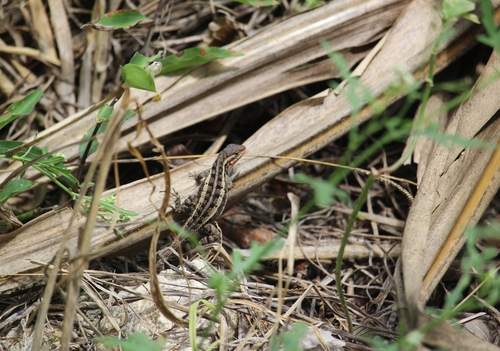
Teapen Rosebelly Lizard
Sceloporus teapensis

Brown Basilisk
Basiliscus vittatus

Yucatán Banded Gecko
Coleonyx elegans

Neotropical Green Anole
Anolis biporcatus

Greater Scaly Anole
Anolis tropidonotus

Fer-de-lance
Bothrops asper

Common House Gecko
Hemidactylus frenatus

Least Gecko
Sphaerodactylus glaucus

Central American Boa
Boa imperator

Speckled Racer
Drymobius margaritiferus
📊 Most Spotted

Central American Gulf Coast Toad
Incilius valliceps

Sheep Frog
Hypopachus variolosus

Giant Marine Toad
Rhinella horribilis

Mexican Smilisca
Smilisca baudinii

Browns' Frog
Lithobates brownorum

Harlequin Treefrog
Dendropsophus ebraccatus

Mexican White-lipped Frog
Leptodactylus fragilis

Yellow Treefrog
Dendropsophus microcephalus
Animal Events
2Ocellated Turkeys on the Plazas
Ocellated turkeys feed in the open on the Great Plaza and around Complex Q, at their most visible of the year.
3Dry-season Waterholes
As the aguadas shrink, Morelet's crocodiles and iguanas concentrate around the remaining water beside the causeways.
1Boreal Migrants Arrive
North American warblers and thrushes winter in the reserve. They are common in the forest around the ruins through the northern winter and effectively absent in the northern summer.

Sighting Calendar
Average chance of spotting the park's most-spotted species, month by month
- 1Boreal Migrants Arrive
- 2Ocellated Turkeys on the Plazas
- 3Dry-season Waterholes
Sighting Zones
Warm areas are where all species together are recorded most, so they track where people go as much as where animals are. For one species, see the map on its own page.
Where Wildlife Score
How good is this park for seeing wildlife?Biodiversity
GoodHow rich is the wildlife?
Sighting
ExcellentHow likely to see animals?
Quick answers
What animals can you see in Tikal National Park?
The most likely sightings are White-nosed Coati (seen by about 90% of wildlife watchers), Brown Jay (seen by about 90% of wildlife watchers), Central American Spider Monkey (seen by about 80% of wildlife watchers), Keel-billed Toucan (seen by about 70% of wildlife watchers), Montezuma Oropendola (seen by about 70% of wildlife watchers) — among 845 recorded vertebrate species, based on citizen-science data from GBIF.
When is the best time to visit Tikal National Park for wildlife?
January has the highest combined sighting rate for the park's top species in our month-by-month GBIF data. The full sighting calendar on this page shows each species' best months.
Can you see Central American Spider Monkey in Tikal National Park?
Yes — about 80% of wildlife watchers report a Central American Spider Monkey sighting in Tikal National Park, based on 149 verified sightings from GBIF citizen-science data.
Can you see Keel-billed Toucan in Tikal National Park?
Yes — about 70% of wildlife watchers report a Keel-billed Toucan sighting in Tikal National Park, based on 1,863 verified sightings from GBIF citizen-science data.
Can you see Mexican Black Howler Monkey in Tikal National Park?
Yes — about 50% of wildlife watchers report a Mexican Black Howler Monkey sighting in Tikal National Park, based on 59 verified sightings from GBIF citizen-science data.
Can you see Ocellated Turkey in Tikal National Park?
Yes — about 60% of wildlife watchers report a Ocellated Turkey sighting in Tikal National Park, based on 1,433 verified sightings from GBIF citizen-science data.
Explore Other Parks
📍 27 km 🦎 Brown Basilisks Skitter Across the Lakeshore Biotopo Cerro Cahuí
📍 100 km 🐒 Spider Monkeys Over Maya Temples Calakmul Biosphere Reserve
_on_foxtail_palm_(Wodyetia_bifurcata)_Cayo.jpg) 📍 114 km 🐒 Jaguar and Howler Monkey Basin
📍 114 km 🐒 Jaguar and Howler Monkey Basin Cockscomb Basin Wildlife Sanctuary
📍 183 km 🐒 Howler Monkey and Macaw Rainforest