
Common Big-eared Bat
Micronycteris microtis
- KingdomAnimalia (Animals)
- PhylumChordata (Chordates)
- ClassMammalia (Mammals)
- OrderChiroptera (Bats)
- FamilyPhyllostomidae (New World Leaf-nosed Bats)
- GenusMicronycteris (Little Big-eared Bats)
- SpeciesMicronycteris microtis (Common Big-eared Bat)
About the Common Big-eared Bat
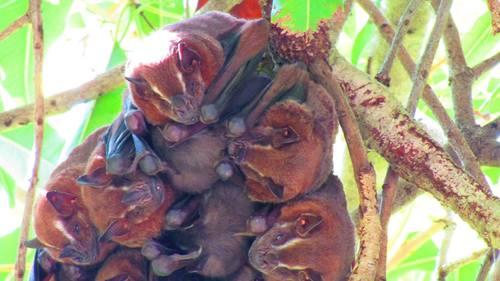
The common big-eared bat (Micronycteris microtis) is a bat species from South and Central America. It is a member of the family Phyllostomidae. Recent research has demonstrated this bat's ability to find motionless food within clutter. Echolocating bats discriminate between background and prey based on glints or Doppler shifts in the echo induced by the (wing-)movements of the prey, but M. microtis can detect completely motionless prey. The species shares both the leaf-nose formation and the trait of sound emission through the nostrils with all Phyllostomidae, but its behavior is understood to be unique: the bat is able to discriminate ecologically relevant stimuli within an extremely complex cluttered sonic environment.
The echolocation call of M. microtis is a broad band multi-harmonic FM sweep with most energy in the second harmonic between 95 and 75 kHz, i.e. quite similar to that of Macrophyllum macrophyllum, although presumably of lower intensity.
M. microtis mothers will provide pups with prey items for 5 months after weaning. It is a small species of bat with individuals weighing 3.4–9.1 g (0.12–0.32 oz). Its forearm length is 32–38 mm (1.3–1.5 in). Its ears... Wikipedia →


Global Distribution
Where this species is recorded worldwide. Restricted to human observations from 2019 onwards — the same kind of record and the same period the probabilities on this page are built from, so collar-tracking studies, camera-trap arrays and museum specimens are excluded. Around Santa Rosa that removes 5,924 GPS fixes from a handful of tagged jaguars.
where this species is recorded (GBIF density — it tracks where observers go, not how likely a sighting is) · parks where it occurs — tap a pin for the sighting probability there
Parks Where Found
| # | Park | Country | Daily sighting probability |
|---|---|---|---|
| 1 | Tikal National Park | 🇬🇹 Guatemala | |
| 2 | Montes Azules Biosphere Reserve | 🇲🇽 Mexico | |
| 3 | Soberanía National Park | 🇵🇦 Panama | |
| 4 | Ría Lagartos Biosphere Reserve | 🇲🇽 Mexico | |
| 5 | Arrecifes de Cozumel National Park | 🇲🇽 Mexico | |
| 6 | Calakmul Biosphere Reserve | 🇲🇽 Mexico | |
| 7 | Arenal Volcano National Park | 🇨🇷 Costa Rica |