

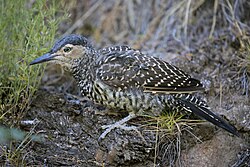



Chilean Flicker
Colaptes pitius
Silhouette: Edwin Price · PhyloPic
- KingdomAnimalia (Animals)
- PhylumChordata (Chordates)
- ClassAves (Birds)
- OrderPiciformes (Woodpeckers and Allies)
- FamilyPicidae (Woodpeckers)
- GenusColaptes (Flickers and Allies)
- SpeciesColaptes pitius (Chilean Flicker)
About the Chilean Flicker
The Chilean flicker (Colaptes pitius) is a species of bird in subfamily Picinae of the woodpecker family Picidae. It is found in Argentina and Chile. The Chilean flicker was originally described as Picus Pitius. For a time it was put in the monotypic genus Pituipicus that was later merged into Colaptes. The Chilean flicker and Andean flicker (C. rupicola) are sister species.
The Chilean flicker is monotypic. The Chilean flicker is about 30 cm (12 in) long and weighs 100 to 163 g (3.5 to 5.7 oz). Males and females have the same plumage except on their heads. Adult males are dark slate gray from forehead to nape; the last occasionally has a hint of red. They are buffish from their lores around the eye to the nape with fine black or black and red spots on the malar area that show as a diffuse patch. Their chin and throat are buffish white with black spots on the lower throat. Adult females have a buffish malar area with no spots and never any red on the nape. Both sexes have blackish brown upperparts with narrow white to buff-white bars; their rump is white with sometimes a few black spots. Their flight feathers are dark brown with pale... Wikipedia →
Recent sightings of Chilean Flicker in Torres del Paine National Park
LIVEiNaturalistClosest Relatives at Torres del Paine National Park


Global Distribution
Warmer areas are where this animal is recorded most often.
Parks Where Found
| # | Park | Country | Daily sighting probability |
|---|---|---|---|
| 1 | Vicente Pérez Rosales National Park | 🇨🇱 Chile | |
| 2 | Nahuel Huapi National Park | 🇦🇷 Argentina | |
| 3 | Torres del Paine National Park | 🇨🇱 Chile |
Quick answers
What are the chances of seeing a Chilean Flicker in Torres del Paine National Park?
About 20% of wildlife watchers report a Chilean Flicker sighting in Torres del Paine National Park, based on 372 verified sightings from GBIF citizen-science data.
When is the best time to see Chilean Flicker in Torres del Paine National Park?
March has the highest sighting rate for Chilean Flicker in Torres del Paine National Park in our monthly data.