
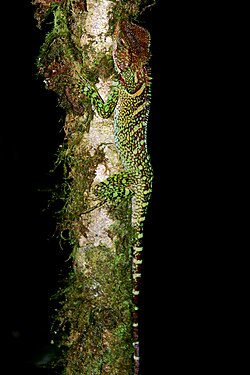



Broad-headed Woodlizard
Enyalioides laticeps
Silhouette: Jose Carlos Arenas-Monroy · PhyloPic
- KingdomAnimalia (Animals)
- PhylumChordata (Chordates)
- ClassSquamata
- FamilyHoplocercidae (Dwarf Iguanas)
- GenusEnyalioides (Woodlizards and Dwarf Iguanas)
- SpeciesEnyalioides laticeps (Broad-headed Woodlizard)
About the Broad-headed Woodlizard
Enyalioides laticeps, the Amazon broad-headed wood lizard, is a dwarf iguanian lizard found abundantly in Amazonian rainforests. They are semi-arboreal. Other common names for these lizards include big-headed stick lizards (lagartijas de palo de cabezonas), Guichenot's dwarf iguana, Amazon dwarf-iguana (Iguana enana amazónica), and Amazon forest dragon.
E. laticeps is a small, ornamented lizard that grows up to 157 millimetres (6.2 in) long and features a very high vertebral crest along its back. They may change color based on environmental factors and rely on rapid running to move around, though they spend the vast majority of their time motionless, blending into the rainforest background (branches, palm fronds) and ambushing prey. When attacked by predators, E. laticeps may remain motionless like a wood stick to avoid predation. If discovered, it may suddenly spring into motion, quickly retreating to burrows in the ground.
The Amazon broad-headed wood lizard has at least sixteen close relatives, most of them found in Amazonian rainforests, such as the red-eyed dwarf-iguana (Enyalioides oshaughnessyi), blue-spotted dwarf-iguana (E. praestabilis), red-throated dwarf... Wikipedia →
Recent sightings of Broad-headed Woodlizard in Yasuní National Park
LIVEiNaturalistClosest Relatives at Yasuní National Park


Global Distribution
Warmer areas are where this animal is recorded most often.
Parks Where Found
| # | Park | Country | Daily sighting probability |
|---|---|---|---|
| 1 | Cuyabeno Wildlife Reserve | 🇪🇨 Ecuador | |
| 2 | Yasuní National Park | 🇪🇨 Ecuador | |
| 3 | Amacayacu National Natural Park | 🇨🇴 Colombia |
Quick answers
What are the chances of seeing a Broad-headed Woodlizard in Yasuní National Park?
About 30% of wildlife watchers report a Broad-headed Woodlizard sighting in Yasuní National Park, based on 72 verified sightings from GBIF citizen-science data.
When is the best time to see Broad-headed Woodlizard in Yasuní National Park?
April has the highest sighting rate for Broad-headed Woodlizard in Yasuní National Park in our monthly data.