
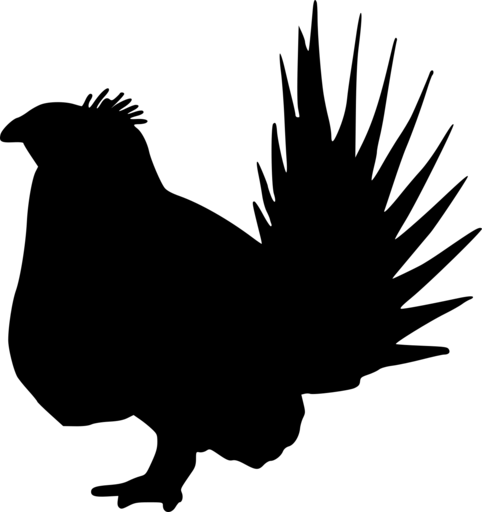
Greater Sage Grouse
Centrocercus urophasianus
Silhouette: Richard Rich · PhyloPic
- KingdomAnimalia (Animals)
- PhylumChordata (Chordates)
- ClassAves (Birds)
- OrderGalliformes (Landfowl)
- FamilyPhasianidae (Pheasants, Grouse, and Allies)
- GenusCentrocercus (Sage-Grouse)
- SpeciesCentrocercus urophasianus (Greater Sage Grouse)
About the Greater Sage Grouse
The greater sage-grouse (Centrocercus urophasianus), also known as the sagehen, is the largest grouse in North America. Its range is sagebrush country in the western United States and southern Alberta and Saskatchewan, Canada. It was known as simply the sage grouse until the Gunnison sage-grouse was recognized as a separate species in 2000. The Mono Basin population of sage grouse may also be distinct.
The greater sage-grouse is a permanent resident in its breeding grounds but may move short distances to lower elevations during winter. It makes use of a complex lek system in mating and nests on the ground under sagebrush or grass patches. It forages on the ground, mainly eating sagebrush but also other plants and insects. Greater sage-grouse do not have a muscular crop and are not able to digest hard seeds like other grouse.
The species is in decline across its range due to habitat loss, and has been recognized as threatened or near threatened by several national and international organizations. Adult greater sage-grouse have a long, pointed tail and legs with feathers to the toes. The adult male has a yellow patch over each eye, is grayish on top with a white breast... Wikipedia →
Recent sightings of Greater Sage Grouse in Yosemite National Park
LIVEiNaturalist


Global Distribution
Warmer areas are where this animal is recorded most often.
Parks Where Found
| # | Park | Country | Daily sighting probability |
|---|---|---|---|
| 1 | Yosemite National Park | 🇺🇸 United States |
More parks will be added in future updates.