
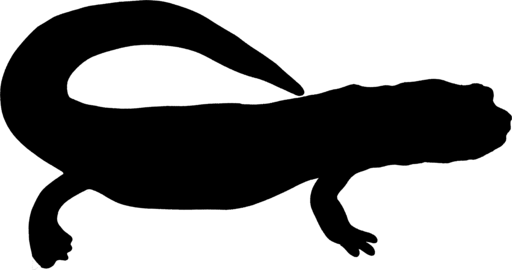
Limestone Salamander
Hydromantes brunus
Silhouette: C. Camilo Julián-Caballero · PhyloPic
- KingdomAnimalia (Animals)
- PhylumChordata (Chordates)
- ClassAmphibia (Amphibians)
- OrderCaudata (Salamanders)
- FamilyPlethodontidae (Lungless Salamanders)
- GenusHydromantes (Web-toed Salamanders)
- SpeciesHydromantes brunus (Limestone Salamander)
About the Limestone Salamander
The limestone salamander (Hydromantes brunus) is a member of the lungless salamander family. Discovered in 1952, this species belongs to a genus endemic to California. It is endemic to a portion of the Merced River Canyon in Mariposa County, California.
The limestone salamander has a flattened body, head, webbed toes, and a short tail. It is typically 5.0-7.5 cm in length. Adults are brownish with a pale ventral surface; the male has oval-shaped mental gland. The species was originally thought to be life-birthing, but is now known to lay eggs. Young hatch in the egg and emerge fully formed, with no larval stage. They are yellowish greenish, darkening with age. Like all lungless salamanders, it respires through its skin.
The genus Hydromantes is endemic to California. The limestone salamander occurs only in the Lower Merced River drainage, in several disparate localities, at elevations of 300–760 m in inhabits canyon slopes that are greater than 35 degrees. Habitats include moss-covered limestones outcroppings, chaparral, under rocks and logs in moist environments. During dry weather it stays underground in caves and rock crevices.
�... Wikipedia →
Recent sightings of Limestone Salamander in Yosemite National Park
LIVEiNaturalistClosest Relatives at Yosemite National Park

 Mount Lyell Salamander
Hydromantes platycephalus

Ensatina
Ensatina eschscholtzii

Gregarious Slender Salamander
Batrachoseps gregarius

 Arboreal Salamander
Aneides lugubris

Hell Hollow Slender Salamander
Batrachoseps diabolicus

 Sierra Newt
Taricha sierrae
Global Distribution
Warmer areas are where this animal is recorded most often.
Parks Where Found
| # | Park | Country | Daily sighting probability |
|---|---|---|---|
| 1 | Yosemite National Park | 🇺🇸 United States |
More parks will be added in future updates.