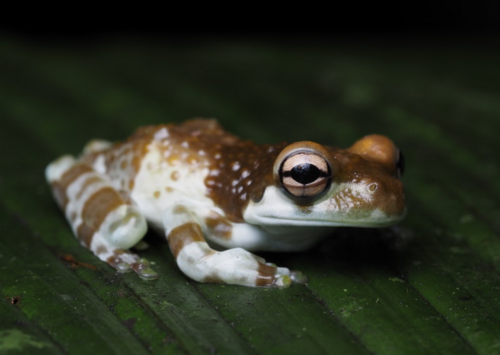

Toad-wife Tree Frog
Trachycephalus cunauaru
Silhouette: Lauren McLean · PhyloPic
- KingdomAnimalia (Animals)
- PhylumChordata (Chordates)
- ClassAmphibia (Amphibians)
- OrderAnura (Frogs and Toads)
- FamilyHylidae (Hylid Tree Frogs)
- GenusTrachycephalus (Golden-eyed Tree Frogs)
- SpeciesTrachycephalus cunauaru (Toad-wife Tree Frog)
About the Toad-wife Tree Frog
Trachycephalus cunauaru is a frog in the family Hylidae. It is endemic to Brazil, Bolivia, and Ecuador, where it lives in rainforest and other forest habitats. Scientists believe it may also live in Colombia and Peru. Scientists have seen it as high as 800 meters above sea level.
The adult male frog measures 57.9 to 74.3 mm long in snout-vent length and the adult female frog 74.4 to 84.9 mm. This frog has a pattern of dark and light brown or gray on its back. Its toes are light green in color. This frog is nocturnal. It frog spends almost all of its life cycle in canopy. It reproduces during the rainy season. The male frog finds a water-filled hole or cavity inside a tree. Then it perches between 2 and 32 meters off the ground and sings to attract a female, who lays her eggs in the water. Scientists believe the frogs are territorial and may compete for good nesting sites. The female frog can lay 1000 eggs per clutch.
The name cunauaru comes from the language of the indigenous people of the Amazon area. The name is onomatopoeia for the frog's call and also sounds like "toad wife." It also refers to the way the male frog calls for the female frog on nights when the moon is bright. Wikipedia →
Recent sightings of Toad-wife Tree Frog in Anavilhanas National Park
LIVEiNaturalistClosest Relatives at Anavilhanas National Park

 Boatman frog
Trachycephalus resinifictrix

 Giant Broad-headed Treefrog
Osteocephalus taurinus

 Rusty Tree Frog
Boana boans

Red Snouted Tree Frog
Scinax ruber

Dwarf Tree Frog
Dendropsophus nanus

Upper Orinoco Tree Frog
Boana wavrini

 Eastern Cane Toad
Rhinella marina

 Smoky Jungle Frog
Leptodactylus pentadactylus

South American Common Toad
Rhinella margaritifera

Loreto White-lipped Frog
Leptodactylus rhodomystax

Snouted Toad
Rhinella proboscidea

 Three-striped Poison Frog
Ameerega trivittata
Global Distribution
Warmer areas are where this animal is recorded most often.
Parks Where Found
| # | Park | Country | Daily sighting probability |
|---|---|---|---|
| 1 | Cuyabeno Wildlife Reserve | 🇪🇨 Ecuador | |
| 2 | Yasuní National Park | 🇪🇨 Ecuador | |
| 3 | Anavilhanas National Park | 🇧🇷 Brazil |