


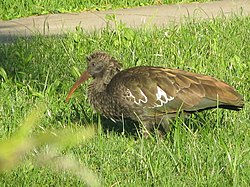


Wattled Ibis
Bostrychia carunculata
Silhouette: Sheatherius · PhyloPic
- KingdomAnimalia (Animals)
- PhylumChordata (Chordates)
- ClassAves (Birds)
- OrderPelecaniformes (Pelicans, Herons, Ibises, and Allies)
- FamilyThreskiornithidae (Ibises and Spoonbills)
- GenusBostrychia (African Crested and Hadada Ibises)
- SpeciesBostrychia carunculata (Wattled Ibis)
About the Wattled Ibis
The wattled ibis (Bostrychia carunculata) is a species of bird in the family Threskiornithidae. It is endemic to the Ethiopian Highlands and is found only in Ethiopia and Eritrea. The Wattled ibis is a medium-sized, dark brown, crested bird, distinguished by the combination of its dark color, its creast and its extensive white wing-patch. It has a relatively short bill, a fairly long tail and a thin wattle hanging from its throat. The basic color of the adult is dark brown. The brown face is feathered with a dusky red bill. The eye is red and surrounded by a white ring. Plumage is glossed dull green; the waddle is small and red, about 20 mm long. Body length is about 65–75 cm.
They may occur all over Ethiopian highlands at altitudes ranging from 1500 m to the highest moorlands at 4100 m. It has also been recorded on the coast of Eritrea. It prefers meadows and highland river courses. It is often found in rocky places and cliffs (where it roosts and breeds), but also in open country, cultivated land, city parks and olive tree (Olea africana) and juniper (Juniperus procera) mixed forests. It has also become well adapted to anthropic landscapes... Wikipedia →
Recent sightings of Wattled Ibis in Bale Mountains National Park
LIVEiNaturalistClosest Relatives at Bale Mountains National Park


Global Distribution
Warmer areas are where this animal is recorded most often.
Parks Where Found
| # | Park | Country | Daily sighting probability |
|---|---|---|---|
| 1 | Bale Mountains National Park | 🇪🇹 Ethiopia | |
| 2 | Awash National Park | 🇪🇹 Ethiopia |
Quick answers
What are the chances of seeing a Wattled Ibis in Bale Mountains National Park?
About 80% of wildlife watchers report a Wattled Ibis sighting in Bale Mountains National Park, based on 235 verified sightings from GBIF citizen-science data.
When is the best time to see Wattled Ibis in Bale Mountains National Park?
December has the highest sighting rate for Wattled Ibis in Bale Mountains National Park in our monthly data.