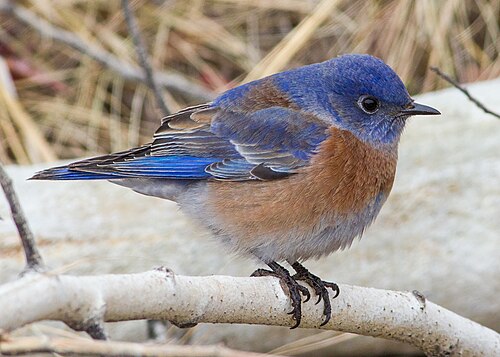


Western Bluebird
Sialia mexicana
Silhouette: Andy Wilson · PhyloPic
- KingdomAnimalia (Animals)
- PhylumChordata (Chordates)
- ClassAves (Birds)
- OrderPasseriformes (Perching Birds)
- FamilyTurdidae (Thrushes)
- GenusSialia (Bluebirds)
- SpeciesSialia mexicana (Western Bluebird)
About the Western Bluebird
The western bluebird (Sialia mexicana) is a small North American thrush. The western bluebird was formally described by the English naturalist William Swainson in 1832 and given the binomial name Sialia mexicana. Six subspecies are recognized:
S. m. occidentalis Townsend, JK, 1837 – southwest Canada to north Baja California (northwest Mexico) S. m. bairdi Ridgway, 1894 – interior west USA to Sonora and Chihuahua (northwest Mexico) S. m. jacoti Phillips, AR, 1991 – south central USA and northeast Mexico
S. m. amabilis Moore, RT, 1939 – northcentral Mexico S. m. nelsoni Phillips, AR, 1991 – central Mexico S. m. mexicana Swainson, 1832 – south central Mexico The western bluebird is a small stocky bird with a length of 15 to 18 cm (5.9 to 7.1 in). The adult male is bright blue on top and on the throat with an orange breast and sides, a brownish patch on back, and a gray belly and undertail coverts. The adult female has a duller blue body, wings, and tail, a gray throat, a dull orange breast, and a gray belly and undertail coverts. Both sexes have a thin straight bill with a fairly short tail. Immature birds have duller colors than the adults, and have... Wikipedia →
Recent sightings of Western Bluebird in Banff National Park
LIVEiNaturalistClosest Relatives at Banff National Park

 Mountain Bluebird
Sialia currucoides

 American Robin
Turdus migratorius

 Swainson's Thrush
Catharus ustulatus

 Varied Thrush
Ixoreus naevius

 Hermit Thrush
Catharus guttatus

Townsend's Solitaire
Myadestes townsendi

Veery
Catharus fuscescens

 Common Raven
Corvus corax

 Dark-eyed Junco
Junco hyemalis

 Yellow-rumped Warbler
Setophaga coronata

 Mountain Chickadee
Poecile gambeli

 Pine Siskin
Spinus pinus
Global Distribution
Warmer areas are where this animal is recorded most often.
Parks Where Found
| # | Park | Country | Daily sighting probability |
|---|---|---|---|
| 1 | Joshua Tree National Park | 🇺🇸 United States | |
| 2 | Yosemite National Park | 🇺🇸 United States | |
| 3 | Reserva de la Biosfera Mariposa Monarca | 🇲🇽 Mexico | |
| 4 | Saguaro National Park | 🇺🇸 United States |