

Diploid Checkered Whiptail
Aspidoscelis tesselatus
Silhouette: Jose Carlos Arenas-Monroy · PhyloPic
- KingdomAnimalia (Animals)
- PhylumChordata (Chordates)
- ClassSquamata
- FamilyTeiidae (Whiptails and Tegus)
- GenusAspidoscelis (Northern Whiptails)
- SpeciesAspidoscelis tesselatus (Diploid Checkered Whiptail)
About the Diploid Checkered Whiptail
The checkered whiptail (Aspidoscelis tesselatus) is a species of lizard found in the southwestern United States in Colorado, Texas and New Mexico, and in northern Mexico in Chihuahua and Coahuila. Many sources believe that the species originated from the hybridization of the marbled whiptail, Aspidoscelis marmoratus, the plateau spotted whiptail, Aspidoscelis septemvittatus, and possibly the six-lined racerunner, Aspidoscelis sexlineatus. It is one of many lizard species known to be parthenogenic. It is sometimes referred to as the common checkered whiptail to differentiate it from several other species known as checkered whiptails.
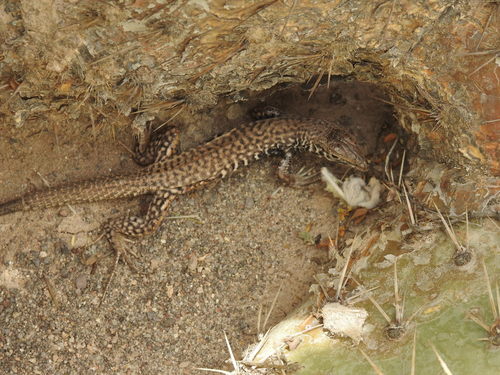
The checkered whiptail grows to about 4 inches in length. Their pattern and base coloration varies widely, with brown or black blotching, checkering or striping on a pale yellow or white base color. Their rear legs often have dark spotting, and their underside is usually white with dark flecking on the throat area. They are slender bodied, with a long tail.
Like other species of whiptail lizard, the checkered whiptail is diurnal and insectivorous. They are wary, energetic, and fast moving, darting for cover if approached... Wikipedia →
Recent sightings of Diploid Checkered Whiptail in Big Bend National Park
LIVEiNaturalist



Global Distribution
Warmer areas are where this animal is recorded most often.
Parks Where Found
| # | Park | Country | Daily sighting probability |
|---|---|---|---|
| 1 | Guadalupe Mountains National Park | 🇺🇸 United States | |
| 2 | Big Bend National Park | 🇺🇸 United States |
Quick answers
What are the chances of seeing a Diploid Checkered Whiptail in Big Bend National Park?
About 20% of wildlife watchers report a Diploid Checkered Whiptail sighting in Big Bend National Park, based on 76 verified sightings from GBIF citizen-science data.
When is the best time to see Diploid Checkered Whiptail in Big Bend National Park?
June has the highest sighting rate for Diploid Checkered Whiptail in Big Bend National Park in our monthly data.