
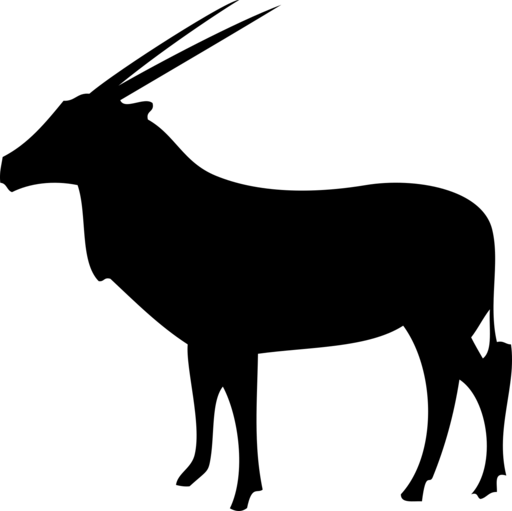
Scimitar-horned Oryx
Oryx dammah
Silhouette: Jan A. Venter, Herbert H. T. Prins, David A. Balfour & Rob Slotow (vectorized by T. Michael Keesey) · PhyloPic
- KingdomAnimalia (Animals)
- PhylumChordata (Chordates)
- ClassMammalia (Mammals)
- OrderArtiodactyla (Even-toed Ungulates and Cetaceans)
- FamilyBovidae (Bovids)
- GenusOryx (Oryxes)
- SpeciesOryx dammah (Scimitar-horned Oryx)
About the Scimitar-horned Oryx
The scimitar oryx (Oryx dammah), also known as the scimitar-horned oryx and the Sahara oryx, is an Oryx species that was once widespread across North Africa and parts of West and Central Africa. In 2000, it was declared extinct in the wild on the IUCN Red List, but in 2023, it was downlisted to endangered, with a reintroduced population in Chad. This particular oryx is adapted to harsh desert conditions and can survive for months without drinking water. A grazing animal, it derives most of its daily moisture intake from plants.
The decline of the scimitar oryx population began as a result of climate change during the Neolithic period, and later it was hunted extensively for its horns. Today, it is bred in captivity in special reserves in Tunisia, Morocco, and Senegal, and on private exotic animal ranches in the Texas Hill Country, United States. In 2016, a reintroduction program was launched, and currently a small herd has been successfully reintroduced in Chad.
The scimitar oryx was the emblem of the ancient Egyptian Oryx nome and today is the animal symbol of the Sahara Conservation Fund. The scimitar oryx is a member of the genus Oryx and the family Bovidae... Wikipedia →
Recent sightings of Scimitar-horned Oryx in Big Bend National Park
LIVEiNaturalist


Global Distribution
Warmer areas are where this animal is recorded most often.
Parks Where Found
| # | Park | Country | Daily sighting probability |
|---|---|---|---|
| 1 | Big Bend National Park | 🇺🇸 United States |
More parks will be added in future updates.