

Texas Blind Snake
Rena dulcis
Silhouette: Jessica Tingle · PhyloPic
- KingdomAnimalia (Animals)
- PhylumChordata (Chordates)
- ClassSquamata
- FamilyLeptotyphlopidae (Threadsnakes)
- GenusRena
- SpeciesRena dulcis (Texas Blind Snake)
About the Texas Blind Snake
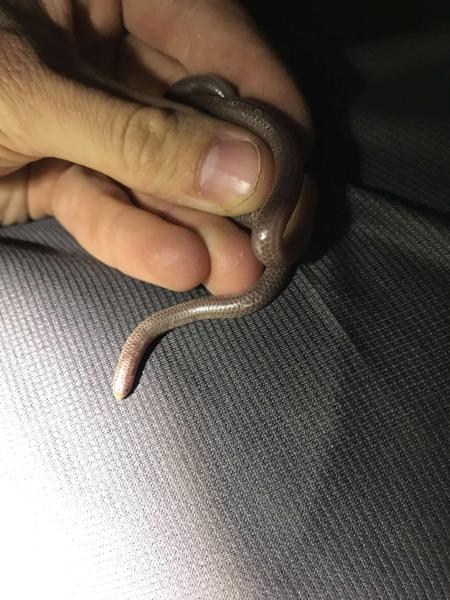
Rena dulcis, also known commonly as the Texas blind snake, the Texas slender blind snake, or the Texas threadsnake, is a species of snake in the family Leptotyphlopidae. The species is endemic to the Southwestern United States and adjacent northern Mexico. Three subspecies are currently recognized, including the nominate subspecies described here.
The Texas blind snake appears much like a shiny earthworm. It is pinkish-brown (puce) in color with a deep sheen to its scales. It appears not to be segmented. The eyes are no more than two dark dots under the head scales. The upper jaw contains no teeth, and the lower jaw is incredibly short (less than half the length of the skull). When ingesting prey, the snake flexes the front of its short lower jaw quickly in a raking motion to fling prey into its esophagus, a technique unique to the family Leptotyphlopidae.
Adults can grow to approximately 27 cm (11 in) in total length, including the tail. On the top of the head, between the ocular scales, L. dulcis has three scales (L. humilis has one scale). R. dulcis is terrestrial, fossorial, and secretive.
The Texas blind snake spends the vast majority of its time... Wikipedia →
Recent sightings of Texas Blind Snake in Big Bend National Park
LIVEiNaturalistClosest Relatives at Big Bend National Park

Global Distribution
Warmer areas are where this animal is recorded most often.
Parks Where Found
| # | Park | Country | Daily sighting probability |
|---|---|---|---|
| 1 | Guadalupe Mountains National Park | 🇺🇸 United States | |
| 2 | Big Bend National Park | 🇺🇸 United States |