
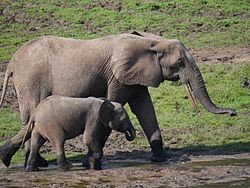



African Forest Elephant
Loxodonta cyclotis
Silhouette: Richard Ruggiero, vectorized by Zimices · PhyloPic
- KingdomAnimalia (Animals)
- PhylumChordata (Chordates)
- ClassMammalia (Mammals)
- OrderProboscidea (Proboscideans)
- FamilyElephantidae (Elephants)
- GenusLoxodonta (African Elephants)
- SpeciesLoxodonta cyclotis (African Forest Elephant)
About the African Forest Elephant
The African forest elephant (Loxodonta cyclotis) is an elephant species native to humid tropical forests in West Africa and the Congo Basin. It was first described in 1900. With an average shoulder height of 2.16 m (7 ft 1 in), it is the smallest of the three extant elephant species. Both sexes have straight, down-pointing tusks, which begin to grow at the age of 1–3 years.
The African forest elephant lives in highly sociable family groups of up to 20 individuals comprising adult cows, their daughters and sons. When young bulls reach sexual maturity, they separate from the family group and form loose bachelor groups for a short time, but usually stay alone. Adult bulls associate with family groups only during the mating season.
The African forest elephant forages on leaves, seeds, fruit, and tree bark of at least 96 plant species. Since it disseminates partly digested seeds for at least 5 km (3.1 mi) through its droppings, it contributes significantly to maintaining the diversity and structure of the Guinean Forests of West Africa and the Congolese rainforests.
During the 20th century, overhunting caused a sharp decline of the African forest elephant population, and by 2013 it was estimated that fewer than 30,000 individuals remained. It is threatened by habitat loss, fragmentation, and poaching. The conservation status of populations varies across range countries. Since 2021, it has been listed as Critically Endangered on the IUCN Red List. Wikipedia →
Recent sightings of African Forest Elephant in Bwindi Impenetrable National Park
LIVEiNaturalistGlobal Distribution
Warmer areas are where this animal is recorded most often.
Parks Where Found
| # | Park | Country | Daily sighting probability |
|---|---|---|---|
| 1 | Kibale National Park | 🇺🇬 Uganda | |
| 2 | Semuliki National Park | 🇺🇬 Uganda | |
| 3 | Volcanoes National Park | 🇷🇼 Rwanda | |
| 4 | Bwindi Impenetrable National Park | 🇺🇬 Uganda | |
| 5 | Virunga National Park | 🇨🇩 Democratic Republic of the Congo |