

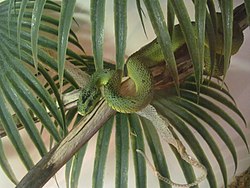


Great Lakes Bush Viper
Atheris nitschei
Silhouette: Steven Traver · PhyloPic
- KingdomAnimalia (Animals)
- PhylumChordata (Chordates)
- ClassSquamata
- FamilyViperidae (Vipers)
- GenusAtheris (Bush Vipers)
- SpeciesAtheris nitschei (Great Lakes Bush Viper)
About the Great Lakes Bush Viper
Common names: Great Lakes bush viper, Nitsche's bush viper, more. Atheris nitschei is a species of venomous snake, a viper in the subfamily Viperinae of the family Viperidae. The species is native to Africa. There are no subspecies that are recognized as being valid.
The former subspecies Atheris nitschei rungweensis from southwestern Tanzania, northeastern Zambia and northern Malawi was elevated to species rank as Atheris rungweensis. The specific name, nitschei, is in honor of German zoologist Hinrich Nitsche (1845–1902).
The 1906 junior synonym, A. woosnami, was in honor of Kenyan game ranger Richard Bowen Woosnam (1880–1915), who later fought in World War I and was killed in action at Gallipoli. Atheris nitschei is a relatively large and stout bush viper, growing to an average total length (tail included) of 60 cm (24 in) and a maximum total length of at least 80 cm (31 in). The males are smaller than the females.
Common names for Atheris nitschei include Great Lakes bush viper, Nitsche's bush viper, black and green bush viper, Nitsche's tree viper. sedge viper, green viper, bush viper. Wikipedia →
Recent sightings of Great Lakes Bush Viper in Bwindi Impenetrable National Park
LIVEiNaturalistClosest Relatives at Bwindi Impenetrable National Park


Global Distribution
Warmer areas are where this animal is recorded most often.
Parks Where Found
| # | Park | Country | Daily sighting probability |
|---|---|---|---|
| 1 | Nyungwe National Park | 🇷🇼 Rwanda | |
| 2 | Bwindi Impenetrable National Park | 🇺🇬 Uganda | |
| 3 | Virunga National Park | 🇨🇩 Democratic Republic of the Congo | |
| 4 | Volcanoes National Park | 🇷🇼 Rwanda | |
| 5 | Queen Elizabeth National Park | 🇺🇬 Uganda |
Quick answers
What are the chances of seeing a Great Lakes Bush Viper in Bwindi Impenetrable National Park?
About 20% of wildlife watchers report a Great Lakes Bush Viper sighting in Bwindi Impenetrable National Park, based on 9 verified sightings from GBIF citizen-science data.
When is the best time to see Great Lakes Bush Viper in Bwindi Impenetrable National Park?
April has the highest sighting rate for Great Lakes Bush Viper in Bwindi Impenetrable National Park in our monthly data.