


Johnston's Chameleon
Trioceros johnstoni
Silhouette: T. Michael Keesey (from a photograph by Frank Glaw, Jörn Köhler, Ted M. Townsend & Miguel Vences) · PhyloPic
- KingdomAnimalia (Animals)
- PhylumChordata (Chordates)
- ClassSquamata
- FamilyChamaeleonidae (Chameleons)
- GenusTrioceros (Equatorial Chameleons)
- SpeciesTrioceros johnstoni (Johnston's Chameleon)
About the Johnston's Chameleon
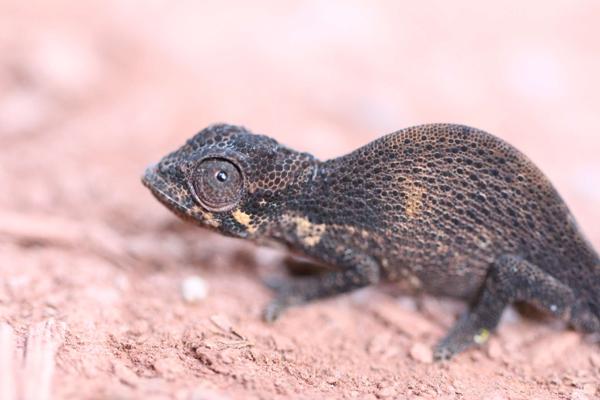
Trioceros johnstoni, known commonly as Johnston's chameleon, Johnston's three-horned chameleon, and the Ruwenzori three-horned chameleon, is a species of chameleon, a lizard in the family Chamaeleonidae. The species is endemic to highlands in the Albertine Rift in central Africa. It reaches up to 30 cm (12 in) in total length (including tail). Only the adult male has three horns. The female is hornless.
The three long annulated horns in the male T. johnstoni makes it superficially similar to T. jacksonii and T. werneri, and to an extent also to the short-horned T. fuelleborni and the smooth-horned T. oweni, but they are not close relatives. Its nearest relative is the hornless T. ituriensis.
The specific name johnstoni was given in honour of the British explorer Harry Johnston. T. johnstoni is found in forests at altitudes between 1,000 and 2,500 m (3,300–8,200 ft) in the Albertine Rift of eastern Democratic Republic of the Congo, western Burundi, western Rwanda, and southwestern Uganda, but also tolerates semi-urbanized environments as long as some trees and bushes remain.
Males of T. johnstoni are fiercely... Wikipedia →
Recent sightings of Johnston's Chameleon in Bwindi Impenetrable National Park
LIVEiNaturalistClosest Relatives at Bwindi Impenetrable National Park



Global Distribution
Warmer areas are where this animal is recorded most often.
Parks Where Found
| # | Park | Country | Daily sighting probability |
|---|---|---|---|
| 1 | Bwindi Impenetrable National Park | 🇺🇬 Uganda | |
| 2 | Virunga National Park | 🇨🇩 Democratic Republic of the Congo | |
| 3 | Nyungwe National Park | 🇷🇼 Rwanda | |
| 4 | Volcanoes National Park | 🇷🇼 Rwanda | |
| 5 | Queen Elizabeth National Park | 🇺🇬 Uganda |
Quick answers
What are the chances of seeing a Johnston's Chameleon in Bwindi Impenetrable National Park?
About 50% of wildlife watchers report a Johnston's Chameleon sighting in Bwindi Impenetrable National Park, based on 78 verified sightings from GBIF citizen-science data.
When is the best time to see Johnston's Chameleon in Bwindi Impenetrable National Park?
January has the highest sighting rate for Johnston's Chameleon in Bwindi Impenetrable National Park in our monthly data.