


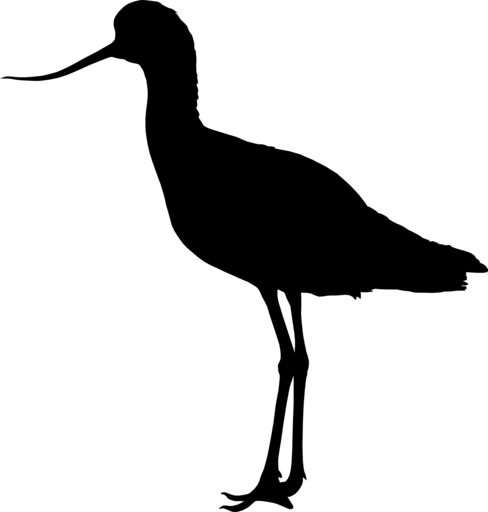
American Avocet
Recurvirostra americana
Silhouette: Alexandre Vong · PhyloPic
- KingdomAnimalia (Animals)
- PhylumChordata (Chordates)
- ClassAves (Birds)
- OrderCharadriiformes (Shorebirds and Allies)
- FamilyRecurvirostridae (Stilts and Avocets)
- GenusRecurvirostra (Avocets)
- SpeciesRecurvirostra americana (American Avocet)
About the American Avocet
The American avocet (Recurvirostra americana) is a large wader in the avocet and stilt family, Recurvirostridae, found in North America. It spends much of its time foraging in shallow water or on mud flats, often sweeping its bill from side to side in water as it seeks crustacean and insect prey.
The American avocet was formally described in 1789 by the German naturalist Johann Friedrich Gmelin in his revised and expanded edition of Carl Linnaeus's Systema Naturae. He placed it with the pied avocet in the genus Recurvirostra and coined the binomial name Recurvirostra americana. Gmelin based his description on that by the English ornithologist John Latham who in 1785 had described and illustrated the American avocet in his A General Synopsis of Birds. Latham cited the earlier publication by William Dampier and also that by Thomas Pennant. The genus name combines the Latin recurvus meaning 'bent' or 'curved backwards' with rostrum meaning 'bill'. The species is monotypic: no subspecies are recognised.
The American avocet is a member of the order Charadriiformes, which includes shorebirds, gulls, and alcids. Its family, Recurvirostridae, includes stilts and avocets. The... Wikipedia →
Recent sightings of American Avocet in Celestún Biosphere Reserve
LIVEiNaturalistClosest Relatives at Celestún Biosphere Reserve

 Black-necked Stilt
Himantopus mexicanus

 Laughing Gull
Leucophaeus atricilla

 Willet
Tringa semipalmata

 Sandwich Tern
Thalasseus sandvicensis

 Royal Tern
Thalasseus maximus

 Spotted Sandpiper
Actitis macularius

 Least Sandpiper
Calidris minutilla

 Lesser Yellowlegs
Tringa flavipes

Grey Gull
Leucophaeus modestus

 Sanderling
Calidris alba

 Greater Yellowlegs
Tringa melanoleuca

 Black-bellied Plover
Pluvialis squatarola
Global Distribution
Warmer areas are where this animal is recorded most often.
Parks Where Found
| # | Park | Country | Daily sighting probability |
|---|---|---|---|
| 1 | El Vizcaíno Biosphere Reserve | 🇲🇽 Mexico | |
| 2 | Celestún Biosphere Reserve | 🇲🇽 Mexico | |
| 3 | Ría Lagartos Biosphere Reserve | 🇲🇽 Mexico | |
| 4 | Everglades National Park | 🇺🇸 United States | |
| 5 | Ciénaga de Zapata | 🇨🇺 Cuba | |
| 6 | Montes Azules Biosphere Reserve | 🇲🇽 Mexico | |
| 7 | Big Cypress National Preserve | 🇺🇸 United States | |
| 8 | Joshua Tree National Park | 🇺🇸 United States | |
| 9 | Saguaro National Park | 🇺🇸 United States | |
| 10 | Point Pelee National Park | 🇨🇦 Canada | |
| 11 | Cabo Pulmo National Park | 🇲🇽 Mexico | |
| 12 | Wood Buffalo National Park | 🇨🇦 Canada | |
| 13 | Arrecifes de Cozumel National Park | 🇲🇽 Mexico | |
| 14 | Shenandoah National Park | 🇺🇸 United States |
Quick answers
What are the chances of seeing a American Avocet in Celestún Biosphere Reserve?
About 10% of wildlife watchers report a American Avocet sighting in Celestún Biosphere Reserve, based on 265 verified sightings from GBIF citizen-science data.
When is the best time to see American Avocet in Celestún Biosphere Reserve?
October has the highest sighting rate for American Avocet in Celestún Biosphere Reserve in our monthly data.