

Mayan Antthrush
Formicarius moniliger
Silhouette: Abraão B. Leite · PhyloPic
- KingdomAnimalia (Animals)
- PhylumChordata (Chordates)
- ClassAves (Birds)
- OrderPasseriformes (Perching Birds)
- FamilyFormicariidae (Antthrushes)
- GenusFormicarius (Formicarius Antthrushes)
- SpeciesFormicarius moniliger (Mayan Antthrush)
About the Mayan Antthrush
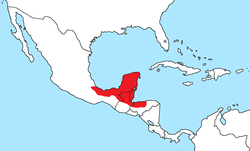
The Mayan antthrush (Formicarius moniliger) is a species of bird in the family Formicariidae. It is found in Belize, Guatemala, Honduras, and Mexico. The Mayan antthrush was formally described as a species by the English ornithologist Philip Slater in 1857. It was later treated by many ornithologists as a subspecies of the black-faced antthrush (Formicarius analis), though some retained it as a species due to significant differences in the two taxa's vocalizations. By 2021 major taxonomic systems had adopted the split.
The Mayan antthrush has three subspecies, the nominate F. m. moniliger (Sclater, PL, 1857), F. m. pallidus (Lawrence, 1882), and F. m. intermedius (Ridgway, 1908). The Mayan antthrush is 15 to 19 cm (5.9 to 7.5 in) long and weighs about 56 to 64 g (2.0 to 2.3 oz). The sexes have the same plumage. Adults of the nominate subspecies have a dusky brown crown. They have a small white spot on their lores and bare bluish skin around their eye. Their face from their bill to their eye is black that extends down to include the chin and throat. The sides of their neck are rufous that continues across under the black throat. Their... Wikipedia →
Recent sightings of Mayan Antthrush in Cockscomb Basin Wildlife Sanctuary
LIVEiNaturalistClosest Relatives at Cockscomb Basin Wildlife Sanctuary

 Spot-breasted Wren
Pheugopedius maculipectus

 Great Kiskadee
Pitangus sulphuratus

 Social Flycatcher
Myiozetetes similis

 White-collared Manakin
Manacus candei

 Melodious Blackbird
Dives dives

 Gray Catbird
Dumetella carolinensis

White-breasted Wood-Wren
Henicorhina leucosticta

 Clay-colored Thrush
Turdus grayi

Lesser Greenlet
Hylophilus decurtatus

 Brown Jay
Psilorhinus morio

 Ivory-billed Woodcreeper
Xiphorhynchus flavigaster

Dusky Antbird
Cercomacra tyrannina
Global Distribution
Warmer areas are where this animal is recorded most often.
Parks Where Found
| # | Park | Country | Daily sighting probability |
|---|---|---|---|
| 1 | Cockscomb Basin Wildlife Sanctuary | 🇧🇿 Belize | |
| 2 | Montes Azules Biosphere Reserve | 🇲🇽 Mexico | |
| 3 | Tikal National Park | 🇬🇹 Guatemala | |
| 4 | Biotopo Cerro Cahuí | 🇬🇹 Guatemala | |
| 5 | Cerro Azul Meámbar National Park | 🇭🇳 Honduras | |
| 6 | Calakmul Biosphere Reserve | 🇲🇽 Mexico | |
| 7 | Sian Ka'an Biosphere Reserve | 🇲🇽 Mexico | |
| 8 | Pico Bonito National Park | 🇭🇳 Honduras | |
| 9 | Cusuco National Park | 🇭🇳 Honduras | |
| 10 | Ría Lagartos Biosphere Reserve | 🇲🇽 Mexico |
Quick answers
What are the chances of seeing a Mayan Antthrush in Cockscomb Basin Wildlife Sanctuary?
About 40% of wildlife watchers report a Mayan Antthrush sighting in Cockscomb Basin Wildlife Sanctuary, based on 685 verified sightings from GBIF citizen-science data.
When is the best time to see Mayan Antthrush in Cockscomb Basin Wildlife Sanctuary?
September has the highest sighting rate for Mayan Antthrush in Cockscomb Basin Wildlife Sanctuary in our monthly data.