


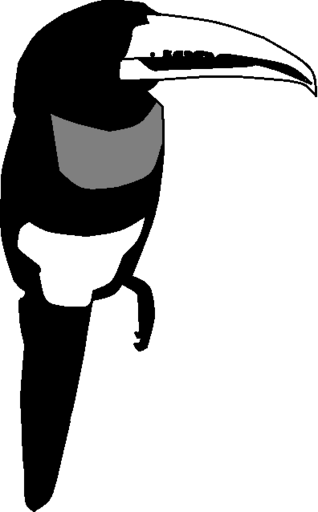
Ivory-billed Aracari
Pteroglossus azara
Silhouette: Edwin Price · PhyloPic
- KingdomAnimalia (Animals)
- PhylumChordata (Chordates)
- ClassAves (Birds)
- OrderPiciformes (Woodpeckers and Allies)
- FamilyRamphastidae (Toucans)
- GenusPteroglossus (Aracaris)
- SpeciesPteroglossus azara (Ivory-billed Aracari)
About the Ivory-billed Aracari
The ivory-billed aracari or ivory-billed araçari (Pteroglossus azara) is a bird in the toucan family Ramphastidae. It is found in Brazil, Colombia, Ecuador, Peru, and Venezuela. The ivory-billed aracari was formally described in 1819 by the French ornithologist Louis Vieillot under the binomial name Ramphastos azara. Vieillot based his account on "Le Toucan-Aracari, Azara" from Brazil that had been described and illustrated in 1807 by the French naturalist François Levaillant. The epithet azara was chosen to honour the Spanish soldier and naturalist Félix de Azara. The ivory-billed aracari is now one of 13 species placed in the genus Pteroglossus that was introduced in 1811 by the German zoologist Johann Karl Wilhelm Illiger.
Three subspecies are recognised: P. a. flavirostris Fraser, 1841 – west Amazonia P. a. azara (Vieillot, 1819) – northwest Amazonian Brazil P. a. mariae Gould, 1854 – southwest Amazonia (brown-mandibled aracari) The subspecies P. a. mariae has sometimes been considered as a separate species, the brown-mandibled aracari.
The ivory-billed aracari is 36 to 45 cm (14 to 18 in) long and weighs 120 to 160 g (4.2 to 5.6 oz). The two subspecies... Wikipedia →
Recent sightings of Ivory-billed Aracari in Cordillera Azul National Park
LIVEiNaturalistClosest Relatives at Cordillera Azul National Park

 Chestnut-eared Aracari
Pteroglossus castanotis

 Lettered Aracari
Pteroglossus inscriptus

 Curl-crested Araçari
Pteroglossus beauharnaisii

 Chestnut-tipped Toucanet
Aulacorhynchus derbianus

 White-throated Toucan
Ramphastos tucanus

Southern Emerald-Toucanet
Aulacorhynchus albivitta

 Channel-billed Toucan
Ramphastos vitellinus

 Black-mandibled Toucan
Ramphastos ambiguus

 Golden-collared Toucanet
Selenidera reinwardtii

 Yellow-tufted Woodpecker
Melanerpes cruentatus

 Gilded Barbet
Capito auratus

Versicoloured Barbet
Eubucco versicolor
Global Distribution
Warmer areas are where this animal is recorded most often.
Parks Where Found
| # | Park | Country | Daily sighting probability |
|---|---|---|---|
| 1 | Cuyabeno Wildlife Reserve | 🇪🇨 Ecuador | |
| 2 | Yasuní National Park | 🇪🇨 Ecuador | |
| 3 | Anavilhanas National Park | 🇧🇷 Brazil | |
| 4 | Tambopata National Reserve | 🇵🇪 Peru | |
| 5 | Madidi National Park | 🇧🇴 Bolivia | |
| 6 | Amacayacu National Natural Park | 🇨🇴 Colombia | |
| 7 | Manu National Park | 🇵🇪 Peru | |
| 8 | Cordillera Azul National Park | 🇵🇪 Peru | |
| 9 | Sierra de la Macarena National Park | 🇨🇴 Colombia | |
| 10 | Podocarpus National Park | 🇪🇨 Ecuador |
Quick answers
What are the chances of seeing a Ivory-billed Aracari in Cordillera Azul National Park?
Under 5% of wildlife watchers report a Ivory-billed Aracari sighting in Cordillera Azul National Park, based on 13 verified sightings from GBIF citizen-science data.
When is the best time to see Ivory-billed Aracari in Cordillera Azul National Park?
February has the highest sighting rate for Ivory-billed Aracari in Cordillera Azul National Park in our monthly data.