



Mair's Keelback
Tropidonophis mairii
Silhouette: Alex Slavenko · PhyloPic
- KingdomAnimalia (Animals)
- PhylumChordata (Chordates)
- ClassSquamata
- FamilyColubridae (Colubrid Snakes)
- GenusTropidonophis (Eastern Keelbacks)
- SpeciesTropidonophis mairii (Mair's Keelback)
About the Mair's Keelback
Tropidonophis mairii, also known commonly as Mair's keelback, the common keelback, and the freshwater snake, is a species of colubrid snake in the subfamily Natricinae. The species is native to Australasia. The specific name, mairii, is in honor of "Dr. Mair", an army surgeon with the 39th Regiment of Foot, who collected the holotype.
Tropidonophis mairii is found in Australia, Indonesia, New Guinea, and Papua New Guinea. The preferred natural habitats of Tropidonophis mairii are forest, grassland, and freshwater wetlands, at altitudes from sea level to 50 m (160 ft).
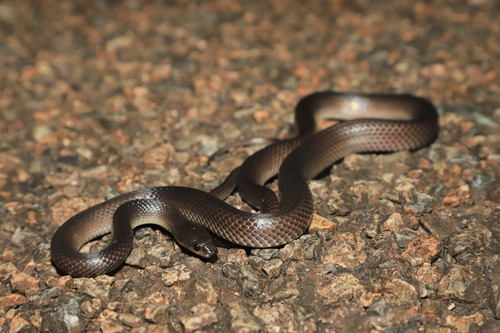
Dorsally, Tropidonophis mairii is olive, brown, or blackish, with small black spots, or with black crossbars anteriorly. Ventrally, it is lighter. The subcaudals and often also the ventrals are edged with black. The dorsal scales are strongly keeled, and arranged in 15 rows at midbody.
It resembles the Australian venomous rough-scaled snake (Tropidechis carinatus). T. mairii rarely grows over 1 m (39 in) in total length (tail included). Tropidonophis mairii is diurnal and nocturnal, arboreal, semi-aquatic, and terrestrial. Wikipedia →
Recent sightings of Mair's Keelback in Daintree National Park
LIVEiNaturalistClosest Relatives at Daintree National Park



Global Distribution
Warmer areas are where this animal is recorded most often.
Parks Where Found
| # | Park | Country | Daily sighting probability |
|---|---|---|---|
| 1 | Litchfield National Park | 🇦🇺 Australia | |
| 2 | Kakadu National Park | 🇦🇺 Australia | |
| 3 | Nitmiluk National Park | 🇦🇺 Australia | |
| 4 | Daintree National Park | 🇦🇺 Australia | |
| 5 | Noosa National Park | 🇦🇺 Australia | |
| 6 | Lamington National Park | 🇦🇺 Australia | |
| 7 | Springbrook National Park | 🇦🇺 Australia |
Quick answers
What are the chances of seeing a Mair's Keelback in Daintree National Park?
About 20% of wildlife watchers report a Mair's Keelback sighting in Daintree National Park, based on 20 verified sightings from GBIF citizen-science data.
When is the best time to see Mair's Keelback in Daintree National Park?
November has the highest sighting rate for Mair's Keelback in Daintree National Park in our monthly data.