


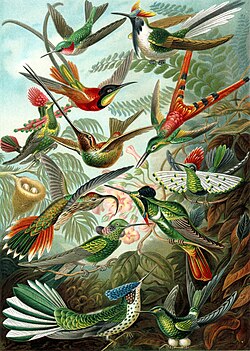

Horned Sungem
Heliactin bilophus
Silhouette: Ferran Sayol · PhyloPic
- KingdomAnimalia (Animals)
- PhylumChordata (Chordates)
- ClassAves (Birds)
- OrderApodiformes (Swifts and Hummingbirds)
- FamilyTrochilidae (Hummingbirds)
- GenusHeliactin
- SpeciesHeliactin bilophus (Horned Sungem)
About the Horned Sungem
The horned sungem (Heliactin bilophus) is a species of hummingbird native to much of central Brazil and parts of Bolivia and Suriname. It prefers open habitats such as savanna and grassland and readily occupies human-created habitats such as gardens. It recently expanded its range into southern Amazonas and Espírito Santo, probably as a result of deforestation; few other hummingbird species have recently expanded their range. The horned sungem is a small hummingbird with a long tail and a comparatively short, black bill. The sexes differ markedly in appearance, with males sporting two feather tufts ("horns") above the eyes that are shiny red, golden, and green. Males also have a shiny blue head crest and a black throat with a pointed "beard". The female is plainer and has a brown or yellow-buff throat. The species is the only one within its genus, Heliactin.
The horned sungem is a nomadic species, moving between areas in response to the seasonal flowering of the plants on which it feeds. It relies on a broad variety of flowering plants for nectar. If the shape of the flower is incompatible with the bird's comparatively short bill, it may rob the nectar through a little hole at the base of the flower. The sungem does also consume small insects. Only the female builds the nest, incubates the eggs, and rears the chicks. She lays two white eggs in a small cup nest which are incubated for about 13 days. The chicks are naked and black after hatching, and can fly when 20 to 22 days old. The horned sungem has been reported to readily defend territories both against members of its own species and against subordinate hummingbird species. The species is currently classified as least concern by the International Union for Conservation of Nature, and its population is thought to be increasing. Wikipedia →
Recent sightings of Horned Sungem in Emas National Park
LIVEiNaturalistClosest Relatives at Emas National Park

 Swallow-tailed Hummingbird
Eupetomena macroura

White-vented Violetear
Colibri serrirostris

 Fork-tailed Woodnymph
Thalurania furcata

 Blue-tufted Starthroat
Heliomaster furcifer

Glittering-bellied Emerald
Chlorostilbon lucidus

Gilded Hummingbird
Hylocharis chrysura

 Reddish Hermit
Phaethornis ruber

Versicolored Emerald
Chrysuronia versicolor

White-tailed Goldenthroat
Polytmus guainumbi

Glittering-throated Emerald
Chionomesa fimbriata

Black-throated Mango
Anthracothorax nigricollis

Planalto Hermit
Phaethornis pretrei
Global Distribution
Warmer areas are where this animal is recorded most often.
Parks Where Found
| # | Park | Country | Daily sighting probability |
|---|---|---|---|
| 1 | Chapada Diamantina National Park | 🇧🇷 Brazil | |
| 2 | Emas National Park | 🇧🇷 Brazil | |
| 3 | Serra da Canastra National Park | 🇧🇷 Brazil | |
| 4 | Chapada dos Guimarães National Park | 🇧🇷 Brazil |
Quick answers
What are the chances of seeing a Horned Sungem in Emas National Park?
About 10% of wildlife watchers report a Horned Sungem sighting in Emas National Park, based on 12 verified sightings from GBIF citizen-science data.
When is the best time to see Horned Sungem in Emas National Park?
May has the highest sighting rate for Horned Sungem in Emas National Park in our monthly data.