


Namib Sand Gecko
Pachydactylus rangei
Silhouette: Emmanuel Jimenez · PhyloPic
- KingdomAnimalia (Animals)
- PhylumChordata (Chordates)
- ClassSquamata
- FamilyGekkonidae (Typical Geckos)
- GenusPachydactylus (Typical Thick-toed Geckos)
- SpeciesPachydactylus rangei (Namib Sand Gecko)
About the Namib Sand Gecko
Pachydactylus rangei, the Namib sand gecko or Namib web-footed gecko, is a species of small lizard in the family Gekkonidae. It inhabits the arid areas of Angola, Namibia, and South Africa, and was first described in 1908 by Swedish zoologist Lars Gabriel Andersson, who named it after its finder, German geologist Dr. Paul Range.
Pachydactylus rangei grows to a length of about 13 cm (5 in) including a 6-centimetre (2.4 in) tail. The head is quite distinct from the slender body and both are flattened dorsally. The eyes are large, dark-coloured and protuberant and have vertical pupils. The web-footed gecko is very pale, nearly translucent. It has a salmon-colored undertone and some have light brown stripes or patterns. Their skin coloration allows for very good camouflage among the sand of the Namib Desert. The skin is covered in fine, smooth scales and is translucent, and some of the internal organs can be seen through it. The legs are thin but the feet are broad, with fully webbed toes, enabling this gecko to burrow easily and to run on loose sand. The gecko developed the webbed feet as an adaptation to help them stay on top of the Namib Desert sand or bury underneath... Wikipedia →
Recent sightings of Namib Sand Gecko in Etosha National Park
LIVEiNaturalistClosest Relatives at Etosha National Park

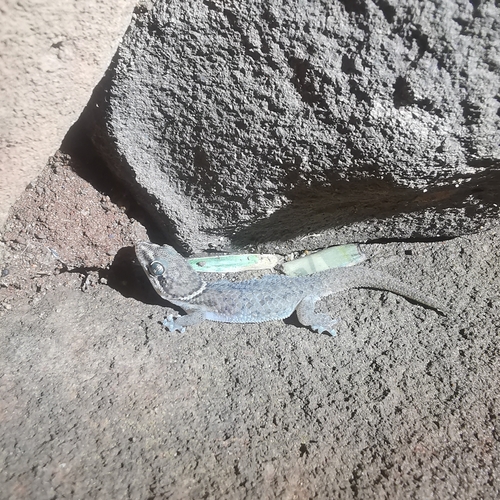
 Pointed Thick-toed Gecko
Pachydactylus punctatus
Large-scaled gecko
Pachydactylus scutatus
Striped Thick-toed Gecko
Pachydactylus fasciatus

 Fischer's Thick-toed Gecko
Chondrodactylus laevigatus
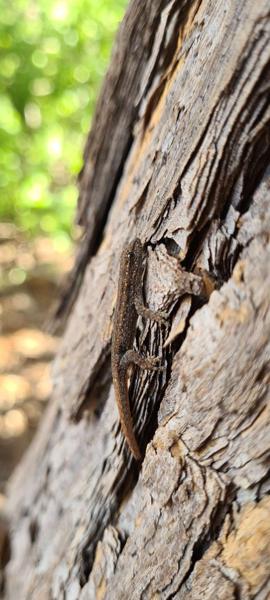
 Bradfield's Dwarf Gecko
Lygodactylus bradfieldi

Barnard's Namib Day Gecko
Rhoptropus barnardi

Boulton's Namib Day Gecko
Rhoptropus boultoni

Lawrence's Dwarf Gecko
Lygodactylus lawrencei

 Bibron's Thick-toed Gecko
Chondrodactylus bibronii
Global Distribution
Warmer areas are where this animal is recorded most often.
Parks Where Found
| # | Park | Country | Daily sighting probability |
|---|---|---|---|
| 1 | Namib-Naukluft National Park | 🇳🇦 Namibia | |
| 2 | Etosha National Park | 🇳🇦 Namibia |