


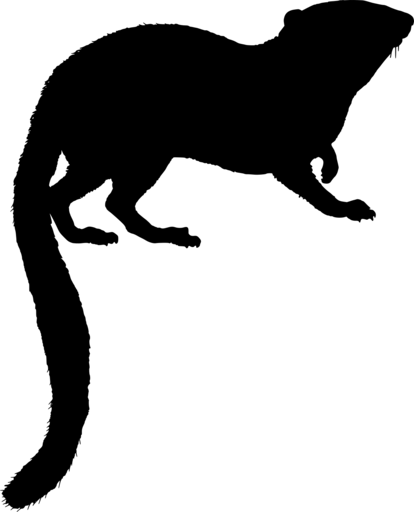
Smith's Bush Squirrel
Paraxerus cepapi
Silhouette: Joseph Smit · PhyloPic
- KingdomAnimalia (Animals)
- PhylumChordata (Chordates)
- ClassMammalia (Mammals)
- OrderRodentia (Rodents)
- FamilySciuridae (Squirrels)
- GenusParaxerus (Bush Squirrels)
- SpeciesParaxerus cepapi (Smith's Bush Squirrel)
About the Smith's Bush Squirrel
Smith's bush squirrel (Paraxerus cepapi), also known as the yellow-footed squirrel or tree squirrel, is an African bush squirrel which is native to woodlands of the southern Afrotropics. It is found in Angola, Botswana, the DRCongo, Malawi, Mozambique, Namibia, South Africa, Tanzania, Zambia, and Zimbabwe. It is a common rodent which is diurnal by nature.
Its total length is 350 mm (14 in), half of which is tail; weight 200 g (7.1 oz). The coat colour varies throughout the region. In the western and arid parts of its range, it is pale grey, and in the eastern localities, more brown. Its head and legs are a rusty colour. Colouration on the chest varies from yellowish to buff in the east, to white in the west. This squirrel's belly is white. These alert and ever busy creatures carry their long tails extended backwards.
Smith's bush squirrels are primarily vegetarian, but like most rodents, they take insect prey and use their front feet to manipulate food items when feeding. They scatter-hoard seeds next to tree trunks or grass tufts, thereby facilitating tree regeneration.
Essentially arboreal animals, they also spend a great deal... Wikipedia →
Recent sightings of Smith's Bush Squirrel in Etosha National Park
LIVEiNaturalistClosest Relatives at Etosha National Park

 Cape Ground Squirrel
Xerus inauris

Congo Rope Squirrel
Funisciurus congicus

 Black-tailed Tree Rat
Thallomys nigricauda

Dassie Rat
Petromus typicus

 Cape Porcupine
Hystrix africaeaustralis

Namaqua Rock Rat
Micaelamys namaquensis

 Pygmy Mouse
Mus minutoides

Cape Four-striped Grass Mouse
Rhabdomys pumilio

 Springhare
Pedetes capensis

Acacia Rat
Thallomys paedulcus

pygmy rock mouse
Petromyscus collinus
Global Distribution
Warmer areas are where this animal is recorded most often.
Parks Where Found
| # | Park | Country | Daily sighting probability |
|---|---|---|---|
| 1 | Liwonde National Park | 🇲🇼 Malawi | |
| 2 | Moremi Game Reserve | 🇧🇼 Botswana | |
| 3 | Etosha National Park | 🇳🇦 Namibia | |
| 4 | Mana Pools National Park | 🇿🇼 Zimbabwe | |
| 5 | Hwange National Park | 🇿🇼 Zimbabwe | |
| 6 | Gonarezhou National Park | 🇿🇼 Zimbabwe | |
| 7 | Lower Zambezi National Park | 🇿🇲 Zambia | |
| 8 | Kruger National Park | 🇿🇦 South Africa | |
| 9 | Kafue National Park | 🇿🇲 Zambia | |
| 10 | Chobe National Park | 🇧🇼 Botswana | |
| 11 | South Luangwa National Park | 🇿🇲 Zambia | |
| 12 | Pilanesberg National Park | 🇿🇦 South Africa | |
| 13 | Waterberg Plateau Park | 🇳🇦 Namibia | |
| 14 | Ruaha National Park | 🇹🇿 Tanzania |
Quick answers
What are the chances of seeing a Smith's Bush Squirrel in Etosha National Park?
About 40% of wildlife watchers report a Smith's Bush Squirrel sighting in Etosha National Park, based on 154 verified sightings from GBIF citizen-science data.
When is the best time to see Smith's Bush Squirrel in Etosha National Park?
November has the highest sighting rate for Smith's Bush Squirrel in Etosha National Park in our monthly data.