



Desert Tree Frog
Litoria rubella
Silhouette: Robbi Bishop-Taylor · PhyloPic
- KingdomAnimalia (Animals)
- PhylumChordata (Chordates)
- ClassAmphibia (Amphibians)
- OrderAnura (Frogs and Toads)
- FamilyPelodryadidae (Australasian Tree Frogs)
- GenusLitoria
- SpeciesLitoria rubella (Desert Tree Frog)
About the Desert Tree Frog
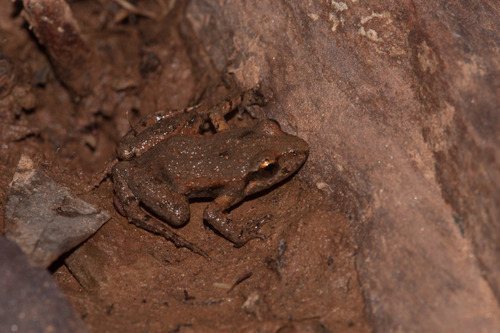
The desert tree frog (Colleeneremia rubella), or little red tree frog, is a species of tree frog native to Australia, southern New Guinea, and Timor. It is one of Australia's most widely distributed frogs, inhabiting northern Australia, including desert regions and much of temperate eastern Australia. It is one of the few Australian tree frogs to inhabit arid, tropical, and temperate climates.
It is rotund, with a small, flat head. It has short arms and strong, short legs. Adults are 28–43 mm (1.1–1.7 in) in snout-vent length. Its ventral surface is white, and the dorsal surface ranges from light grey to dark red and has small black flecks. Adult specimens from Cooktown, Queensland, often show a pronounced metallic sheen on the dorsal surface, ranging in colour from bronze to gold. A dark band runs from the snout, across the eye, and along the flanks of the frog. The throats of males in breeding season are a dark grey colour. The groin is lemon-yellow, and the tympanum is visible. Baby frogs have an almost transparent abdomen, allowing a clear view of their abdominal organs.
The wide distribution and the large range of habitats it inhabits... Wikipedia →
Recent sightings of Desert Tree Frog in Flinders Ranges National Park
LIVEiNaturalistClosest Relatives at Flinders Ranges National Park


Global Distribution
Warmer areas are where this animal is recorded most often.
Parks Where Found
| # | Park | Country | Daily sighting probability |
|---|---|---|---|
| 1 | Litchfield National Park | 🇦🇺 Australia | |
| 2 | Flinders Ranges National Park | 🇦🇺 Australia | |
| 3 | Kakadu National Park | 🇦🇺 Australia | |
| 4 | Nitmiluk National Park | 🇦🇺 Australia |
Quick answers
What are the chances of seeing a Desert Tree Frog in Flinders Ranges National Park?
About 30% of wildlife watchers report a Desert Tree Frog sighting in Flinders Ranges National Park, based on 15 verified sightings from GBIF citizen-science data.
When is the best time to see Desert Tree Frog in Flinders Ranges National Park?
December has the highest sighting rate for Desert Tree Frog in Flinders Ranges National Park in our monthly data.