
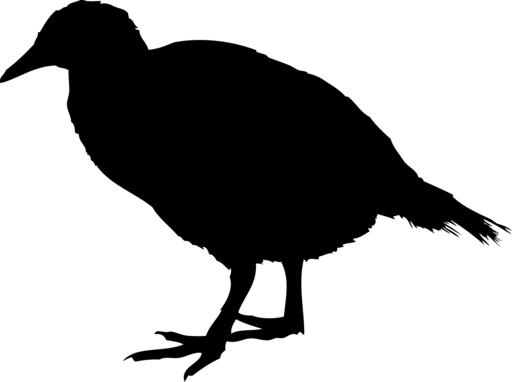
Galapagos Crake
Laterallus spilonotus
Silhouette: T. Michael Keesey (vectorization) and HuttyMcphoo (photography) · PhyloPic
- KingdomAnimalia (Animals)
- PhylumChordata (Chordates)
- ClassAves (Birds)
- OrderGruiformes (Cranes, Rails, and Allies)
- FamilyRallidae (Rails, Gallinules, and Coots)
- GenusLaterallus (Laterallus Crakes)
- SpeciesLaterallus spilonotus (Galapagos Crake)
About the Galapagos Crake
The Galapagos crake (Laterallus spilonota), also called the Galapagos rail and Darwin's rail, is a vulnerable species of rail in subfamily Rallinae of family Rallidae, the rails, gallinules, and coots. It is endemic to the Galápagos Islands. It resembles its sister species, the black rail of the Americas, from which it diverged 1.2 million years ago.
The Galapagos crake was originally described as Zapornia spilonota and has been moved among at least five other scientific names before its current binomial was adopted. At least one author classified it as a subspecies of black rail, and others consider the black rail and Galapagos crake to form a superspecies.
The Galapagos crake is monotypic. The Galapagos crake is about 15 cm (5.9 in) long and weighs about 35 to 45 g (1.2 to 1.6 oz). The sexes are alike. Adults have a dark gray crown and medium gray head and underparts. Their flanks and thighs have sparse narrow whitish bars. Their interscapulars, scapulars, and upper back are chestnut brown and the lower back, rump, uppertail coverts, and tail are dark brown. Their upper wing coverts also are brown, and may have fine white spots, and... Wikipedia →
Recent sightings of Galapagos Crake in Galápagos Islands
LIVEiNaturalistClosest Relatives at Galápagos Islands


Global Distribution
Warmer areas are where this animal is recorded most often.
Parks Where Found
| # | Park | Country | Daily sighting probability |
|---|---|---|---|
| 1 | Galápagos Islands | 🇪🇨 Ecuador |
More parks will be added in future updates.
Quick answers
What are the chances of seeing a Galapagos Crake in Galápagos Islands?
Under 5% of wildlife watchers report a Galapagos Crake sighting in Galápagos Islands, based on 326 verified sightings from GBIF citizen-science data.
When is the best time to see Galapagos Crake in Galápagos Islands?
July has the highest sighting rate for Galapagos Crake in Galápagos Islands in our monthly data.