



Pearl-breasted Swallow
Hirundo dimidiata
Silhouette: Matt Wilkins · PhyloPic
- KingdomAnimalia (Animals)
- PhylumChordata (Chordates)
- ClassAves (Birds)
- OrderPasseriformes (Perching Birds)
- FamilyHirundinidae (Swallows and Martins)
- GenusHirundo (Typical Swallows)
- SpeciesHirundo dimidiata (Pearl-breasted Swallow)
About the Pearl-breasted Swallow
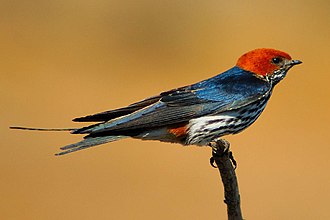
The pearl-breasted swallow (Hirundo dimidiata) is a small swallow. The pearl-breasted swallow is 13–14 cm long. It has glossy blue upperparts and grey-white underparts. The upper wings, underwing flight feathers and forked tail are blackish-blue. The underwing coverts are a darker shade of grey-white. The lack of white in the tail is a distinction from similar Hirundo species. The outer feathers are slightly longer in the male than the female. Juveniles are duller and browner than the adult, with shorter outer tail feathers. The northern subspecies, H. d. marwitzi is darker and smaller than nominate H. d. dimidiata, but the differences are small, and the species may be monotypic.
The pearl-breasted swallow breeds in southern Africa from Angola, southern Congo and Tanzania southwards. It is sparsely distributed, but can be locally common. It is partially migratory with many birds from the southwest of South Africa wintering further north. This is a bird of dry scrub, farmland and clearings. It is often found around human habitation.
The pearl-breasted swallow feeds mainly on flying insects, with a fast direct flight. The... Wikipedia →
Recent sightings of Pearl-breasted Swallow in Garden Route National Park
LIVEiNaturalistClosest Relatives at Garden Route National Park

 White-throated Swallow
Hirundo albigularis

Barn Swallow
Hirundo rustica

 Black Sawwing
Psalidoprocne pristoptera

 Greater Striped-Swallow
Cecropis cucullata

Rock Martin
Ptyonoprogne fuligula

 Plain Martin
Riparia paludicola
Lesser Striped-Swallow
Cecropis abyssinica

Banded Martin
Riparia cincta

 House Martin
Delichon urbicum

 Cape White-eye
Zosterops virens

 Fork-tailed Drongo
Dicrurus adsimilis

 Sombre Greenbul
Andropadus importunus
Global Distribution
Warmer areas are where this animal is recorded most often.
Parks Where Found
| # | Park | Country | Daily sighting probability |
|---|---|---|---|
| 1 | Addo Elephant National Park | 🇿🇦 South Africa | |
| 2 | Pilanesberg National Park | 🇿🇦 South Africa | |
| 3 | Gonarezhou National Park | 🇿🇼 Zimbabwe | |
| 4 | Moremi Game Reserve | 🇧🇼 Botswana | |
| 5 | Chobe National Park | 🇧🇼 Botswana | |
| 6 | Namib-Naukluft National Park | 🇳🇦 Namibia | |
| 7 | Etosha National Park | 🇳🇦 Namibia | |
| 8 | Hwange National Park | 🇿🇼 Zimbabwe | |
| 9 | Kruger National Park | 🇿🇦 South Africa | |
| 10 | Kafue National Park | 🇿🇲 Zambia | |
| 11 | Garden Route National Park | 🇿🇦 South Africa | |
| 12 | Table Mountain National Park | 🇿🇦 South Africa | |
| 13 | Kgalagadi Transfrontier Park | 🇿🇦 South Africa | |
| 14 | Mana Pools National Park | 🇿🇼 Zimbabwe | |
| 15 | South Luangwa National Park | 🇿🇲 Zambia | |
| 16 | Lower Zambezi National Park | 🇿🇲 Zambia |
Quick answers
What are the chances of seeing a Pearl-breasted Swallow in Garden Route National Park?
Under 5% of wildlife watchers report a Pearl-breasted Swallow sighting in Garden Route National Park, based on 7 verified sightings from GBIF citizen-science data.
When is the best time to see Pearl-breasted Swallow in Garden Route National Park?
September has the highest sighting rate for Pearl-breasted Swallow in Garden Route National Park in our monthly data.