


Great Thick-knee
Esacus recurvirostris
- KingdomAnimalia (Animals)
- PhylumChordata (Chordates)
- ClassAves (Birds)
- OrderCharadriiformes (Shorebirds and Allies)
- FamilyBurhinidae (Stone-curlews and Thick-knees)
- GenusEsacus (Greater Stone-curlews)
- SpeciesEsacus recurvirostris (Great Thick-knee)
About the Great Thick-knee
The great stone-curlew or great thick-knee (Esacus recurvirostris) is a large wader which is a resident breeder in tropical southern Asia from India, Pakistan, Sri Lanka, Bangladesh into South-east Asia. The great stone-curlew was formally described in 1829 by the French naturalist Georges Cuvier and given the binomial name Oedicnemus recurvirostris. The type locality is Nepal. The specific epithet recurvirostris combines Latin recurvis meaning "bent backwards" with -rostris meaning "-billed". The species is now placed in the genus Esacus that was introduced in 1831 to accommodate the great stone-curlew by the French naturalist René Lesson. The species is monotypic: no subspecies are recognised.
The great thick-knee is a large wader at 49–55 cm, and has a massive 7 cm bill with the lower mandible with a sharp angle giving it an upturned appearance. It has unstreaked grey-brown upperparts and breast, with rest of the underparts whitish. The face has a striking black and white pattern, and the bill is black with a yellow base. The eyes are bright yellow and the legs a duller greenish-yellow. In flight, the great thick-knee shows black and white flight... Wikipedia →
Closest Relatives at Gir National Park

Indian Thick-knee
Burhinus indicus

Red-wattled Lapwing
Vanellus indicus
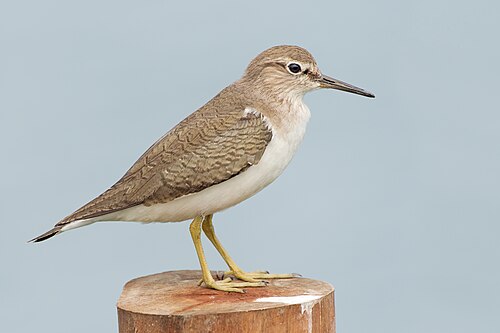
Common Sandpiper
Actitis hypoleucos

River Tern
Sterna aurantia

Yellow-wattled Lapwing
Vanellus malabaricus

Barred Buttonquail
Turnix suscitator

Black-winged Stilt
Himantopus himantopus

Green Sandpiper
Tringa ochropus

Whimbrel
Numenius phaeopus

Little Stint
Calidris minuta
Global Distribution
Where this species is recorded worldwide. Restricted to human observations from 2019 onwards — the same kind of record and the same period the probabilities on this page are built from, so collar-tracking studies, camera-trap arrays and museum specimens are excluded. Around Santa Rosa that removes 5,924 GPS fixes from a handful of tagged jaguars.
where this species is recorded (GBIF density — it tracks where observers go, not how likely a sighting is) · parks where it occurs — tap a pin for the sighting probability there
Parks Where Found
| # | Park | Country | Daily sighting probability |
|---|---|---|---|
| 1 | Yala National Park | 🇱🇰 Sri Lanka | |
| 2 | Wilpattu National Park | 🇱🇰 Sri Lanka | |
| 3 | Ranthambore National Park | 🇮🇳 India | |
| 4 | Kaziranga National Park | 🇮🇳 India | |
| 5 | Satpura National Park | 🇮🇳 India | |
| 6 | Minneriya National Park | 🇱🇰 Sri Lanka | |
| 7 | Jim Corbett National Park | 🇮🇳 India | |
| 8 | Keoladeo National Park | 🇮🇳 India | |
| 9 | Manas National Park | 🇮🇳 India | |
| 10 | Kanha National Park | 🇮🇳 India | |
| 11 | Gir National Park | 🇮🇳 India | |
| 12 | Bandhavgarh National Park | 🇮🇳 India | |
| 13 | Sundarbans National Park | 🇮🇳 India | |
| 14 | Chitwan National Park | 🇳🇵 Nepal |