


River Tern
Sterna aurantia
- KingdomAnimalia (Animals)
- PhylumChordata (Chordates)
- ClassAves (Birds)
- OrderCharadriiformes (Shorebirds and Allies)
- FamilyLaridae (Gulls, Terns, and Skimmers)
- GenusSterna (Typical Terns)
- SpeciesSterna aurantia (River Tern)
About the River Tern
The river tern or Indian river tern (Sterna aurantia) is a tern in the family Laridae, the largest species currently included in the genus Sterna of typical terns. It is a resident breeder along inland rivers from Pakistan east through the Indian subcontinent, to Myanmar, Thailand, and Cambodia, where it is uncommon. Unlike most Sterna terns, it is almost exclusively found on freshwater, rarely venturing even to tidal creeks.
It is a medium-large tern, 38–46 cm long with an 80–85 cm wingspan, distinctly larger than any other species in Sterna and more comparable in size to a Sandwich tern (Thalasseus sandvicensis) or a lesser crested tern (T. bengalensis). It has dark grey upperparts, white or very pale grey underparts, a forked tail with long flexible streamers, and long pointed wings with pale grey primaries. The bill is stout for a tern, bright yellow in summer and duller yellow with a dusky tip in winter, and the legs bright red. It has a black cap in breeding plumage, which is more extensive than in other Sterna terns, extending well below the eye instead of barely or not below the eye. In winter the cap is greyish white, flecked and streaked with black, with... Wikipedia →
Closest Relatives at Gir National Park

Red-wattled Lapwing
Vanellus indicus
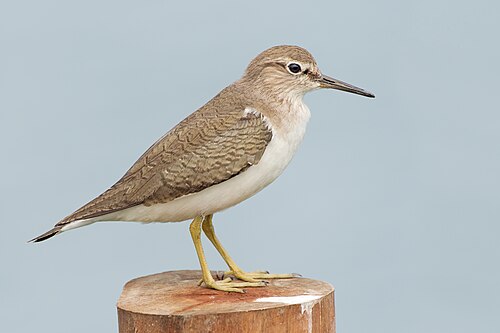
Common Sandpiper
Actitis hypoleucos

Indian Thick-knee
Burhinus indicus

Yellow-wattled Lapwing
Vanellus malabaricus

Barred Buttonquail
Turnix suscitator

Black-winged Stilt
Himantopus himantopus

Green Sandpiper
Tringa ochropus

Great Thick-knee
Esacus recurvirostris

Whimbrel
Numenius phaeopus

Little Stint
Calidris minuta
Global Distribution
Where this species is recorded worldwide. Restricted to human observations from 2019 onwards — the same kind of record and the same period the probabilities on this page are built from, so collar-tracking studies, camera-trap arrays and museum specimens are excluded. Around Santa Rosa that removes 5,924 GPS fixes from a handful of tagged jaguars.
where this species is recorded (GBIF density — it tracks where observers go, not how likely a sighting is) · parks where it occurs — tap a pin for the sighting probability there
Parks Where Found
| # | Park | Country | Daily sighting probability |
|---|---|---|---|
| 1 | Bandipur National Park | 🇮🇳 India | |
| 2 | Ranthambore National Park | 🇮🇳 India | |
| 3 | Satpura National Park | 🇮🇳 India | |
| 4 | Kaziranga National Park | 🇮🇳 India | |
| 5 | Keoladeo National Park | 🇮🇳 India | |
| 6 | Jim Corbett National Park | 🇮🇳 India | |
| 7 | Nagarhole National Park | 🇮🇳 India | |
| 8 | Periyar National Park | 🇮🇳 India | |
| 9 | Gir National Park | 🇮🇳 India | |
| 10 | Bandhavgarh National Park | 🇮🇳 India | |
| 11 | Kanha National Park | 🇮🇳 India | |
| 12 | Mudumalai National Park | 🇮🇳 India | |
| 13 | Manas National Park | 🇮🇳 India |
Quick answers
What are the chances of seeing a River Tern in Gir National Park?
About 10% of wildlife watchers report a River Tern sighting in Gir National Park, based on 13 verified sightings from GBIF citizen-science data.
When is the best time to see River Tern in Gir National Park?
November has the highest sighting rate for River Tern in Gir National Park in our monthly data.