

Ocoee Salamander
Desmognathus ocoee
Silhouette: Beth Reinke · PhyloPic
- KingdomAnimalia (Animals)
- PhylumChordata (Chordates)
- ClassAmphibia (Amphibians)
- OrderCaudata (Salamanders)
- FamilyPlethodontidae (Lungless Salamanders)
- GenusDesmognathus (Dusky Salamanders)
- SpeciesDesmognathus ocoee (Ocoee Salamander)
About the Ocoee Salamander
The ocoee salamander (Desmognathus ocoee) is a species of salamander in the family Plethodontidae. This salamander has a variety of colors and patterns, and got its name from Tennessee state wildflower. Its natural habitats are temperate forests, rivers, intermittent rivers, freshwater springs and wet rocks in mountainous areas of the Southeastern United States. It was first described by Nicholls in 1949. They are territorial and feed on small invertebrates. It is widely distributed in the southeastern United States and is listed as "Least Concern" by the International Union for Conservation of Nature.
The ocoee salamander (Desmognathus ocoee) is a small mountain dusky salamander that exhibits a wide range of colors and patterns. The species got its name from the Tennessee state wildflower and symbol Passiflora incarnata (passionflower), which is termed "ocoee" in the Cherokee tribe. The Ocoee River and the Ocoee salamander were thus named after the Cherokee word for passionflower. Some individuals have distinct red, yellow, or orange patches on their legs and cheeks. Populations in central Tennessee, northwestern Georgia, and northeastern Alabama usually have a dark... Wikipedia →
Recent sightings of Ocoee Salamander in Great Smoky Mountains National Park
LIVEiNaturalistClosest Relatives at Great Smoky Mountains National Park

 Seal Salamander
Desmognathus monticola

Imitator Salamander
Desmognathus imitator

Pygmy Salamander
Desmognathus wrighti
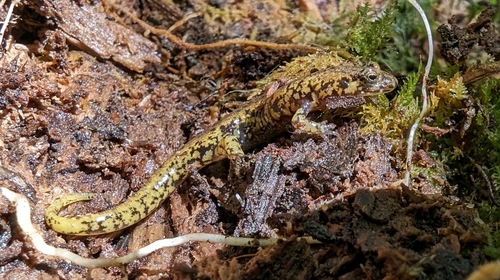
Cherokee Mountain Dusky Salamander
Desmognathus adatsihi

Santeetlah Dusky Salamander
Desmognathus santeetlah

Spotted Dusky Salamander
Desmognathus conanti

Central Shovel-nosed Dusky Salamander
Desmognathus intermedius

Carolina Mountain Dusky Salamander
Desmognathus carolinensis
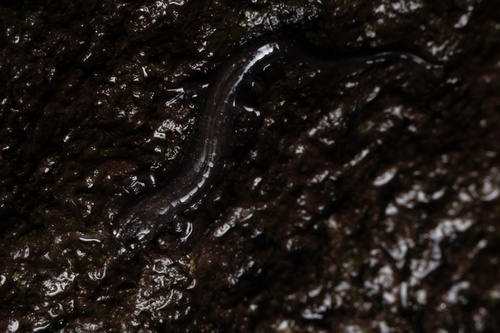
Great Balsams Mountain Dusky Salamander
Desmognathus balsameus

 Blue Ridge Two-lined Salamander
Eurycea wilderae

 Red-cheeked Salamander
Plethodon jordani

 Spring Salamander
Gyrinophilus porphyriticus
Global Distribution
Warmer areas are where this animal is recorded most often.
Parks Where Found
| # | Park | Country | Daily sighting probability |
|---|---|---|---|
| 1 | Great Smoky Mountains National Park | 🇺🇸 United States |
More parks will be added in future updates.