
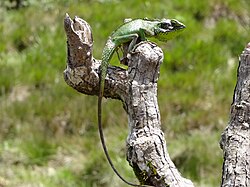



Black-cheek lizard
Calotes nigrilabris
Silhouette: Vijay Karthick · PhyloPic
- KingdomAnimalia (Animals)
- PhylumChordata (Chordates)
- ClassSquamata
- FamilyAgamidae (Dragons)
- GenusCalotes (Oriental Forest Lizards)
- SpeciesCalotes nigrilabris (Black-cheek lizard)
About the Black-cheek lizard
Calotes nigrilabris, the black-cheek lizard, is an agamid species endemic to Sri Lanka. It can be distinguished easily from painted-lipped lizard by having black bar on mouth rather than white or orange bar.In Sinhalese language, it is known as "Kalu Kopul Katussa - කළු කොපුල් කටුස්සා"
A submontane and montane species, found at elevations of 1,000 m (3,300 ft) and above. This species is tolerably common at localities such as Nuwara Eliya, Pattipola, Ohiya, Hakgala Strict Nature Reserve, Horton Plains National Park, Peak Wilderness Sanctuary, Kandapola, Ragala, Labukele, Knuckles, Pidurutalagala, Kuda Oya, Labugolla
Head is one and a half times width. A row of spines above and at the back of tympanum. Adult male is with swollen cheeks. Gular sacs are not developed. Mid body scale rows are 42–50. Ventrals are larger than dorsals. Dorsum is green unpatterned or with black edged, cream transverse bars or eye-like spots. Head with black markings. Venter is pale green.
This species is largely arboreal, inhabiting tree trunks, hedges, and shrubs, where it hunts for insects and worms by day. In Horton Plains C. nigrilabris can be found residing... Wikipedia →
Recent sightings of Black-cheek lizard in Horton Plains National Park
LIVEiNaturalistClosest Relatives at Horton Plains National Park


Global Distribution
Warmer areas are where this animal is recorded most often.
Parks Where Found
| # | Park | Country | Daily sighting probability |
|---|---|---|---|
| 1 | Horton Plains National Park | 🇱🇰 Sri Lanka |
More parks will be added in future updates.
Quick answers
What are the chances of seeing a Black-cheek lizard in Horton Plains National Park?
About 90% of wildlife watchers report a Black-cheek lizard sighting in Horton Plains National Park, based on 72 verified sightings from GBIF citizen-science data.
When is the best time to see Black-cheek lizard in Horton Plains National Park?
April has the highest sighting rate for Black-cheek lizard in Horton Plains National Park in our monthly data.