


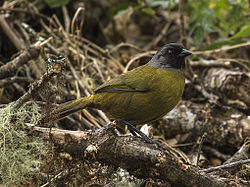

Large-footed Finch
Pezopetes capitalis
Silhouette: L. Shyamal · PhyloPic
- KingdomAnimalia (Animals)
- PhylumChordata (Chordates)
- ClassAves (Birds)
- OrderPasseriformes (Perching Birds)
- FamilyPasserellidae (New World Sparrows)
- GenusPezopetes
- SpeciesPezopetes capitalis (Large-footed Finch)
About the Large-footed Finch
The large-footed finch (Pezopetes capitalis) is a species of bird that despite its name is in the family Passerellidae, the New World sparrows. It is found in Costa Rica and Panama. The large-footed finch was formally described by Jean Cabanis in 1861 with its current binomial Pezopetes capitalis. Cabanis erected the genus Pezopetes for this species and placed it in the finch family Fringillidae.
The large-footed finch eventually was reassigned to its current sparrow family. It remains the only member of the genus and has no subspecies. The large-footed finch is one of the heaviest in its diverse family. It is 17 to 20 cm (6.7 to 7.9 in) long and weighs about 56 g (2.0 oz). It has a long tail and very large legs and feet but a disproportionately small slender bill. The sexes have the same plumage. Adults have a black crown and a dark gray supercilium. Their face from the bill to just past the eye and down through the throat is black and the rest of their face and their nape are dark gray. Their upperparts and wing coverts are olive green. Their tail is blackish with thin olive green feather edges. Their flight feathers are dusky with... Wikipedia →
Recent sightings of Large-footed Finch in Irazú Volcano National Park
LIVEiNaturalistClosest Relatives at Irazú Volcano National Park

 Rufous-collared Sparrow
Zonotrichia capensis

 Sooty-capped Bush-Tanager
Chlorospingus pileatus

Volcano Junco
Junco vulcani

Yellow-thighed Finch
Atlapetes tibialis

Common Chlorospingus
Chlorospingus flavopectus

White-naped Brush-Finch
Atlapetes albinucha

 Chestnut-capped Brushfinch
Arremon brunneinucha

 White-eared Ground-Sparrow
Melozone leucotis

 Sooty Thrush
Turdus nigrescens

 Slaty Flowerpiercer
Diglossa plumbea

 Wilson's Warbler
Cardellina pusilla

Flame-throated Warbler
Oreothlypis gutturalis
Global Distribution
Warmer areas are where this animal is recorded most often.
Parks Where Found
| # | Park | Country | Daily sighting probability |
|---|---|---|---|
| 1 | Irazú Volcano National Park | 🇨🇷 Costa Rica | |
| 2 | Los Quetzales National Park | 🇨🇷 Costa Rica | |
| 3 | Tapantí-Macizo de la Muerte National Park | 🇨🇷 Costa Rica | |
| 4 | Poás Volcano National Park | 🇨🇷 Costa Rica | |
| 5 | Volcán Barú National Park | 🇵🇦 Panama | |
| 6 | Chirripó National Park | 🇨🇷 Costa Rica | |
| 7 | La Amistad International Park (Panama) | 🇵🇦 Panama | |
| 8 | Braulio Carrillo National Park | 🇨🇷 Costa Rica | |
| 9 | Arenal Volcano National Park | 🇨🇷 Costa Rica |
Quick answers
What are the chances of seeing a Large-footed Finch in Irazú Volcano National Park?
About 50% of wildlife watchers report a Large-footed Finch sighting in Irazú Volcano National Park, based on 398 verified sightings from GBIF citizen-science data.
When is the best time to see Large-footed Finch in Irazú Volcano National Park?
July has the highest sighting rate for Large-footed Finch in Irazú Volcano National Park in our monthly data.