


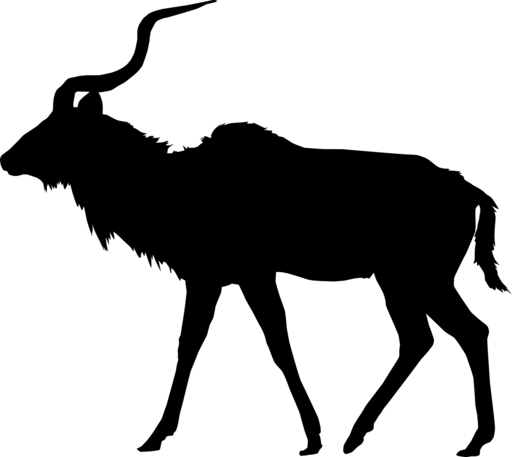
Nyala
Tragelaphus angasii
Silhouette: Margot Michaud · PhyloPic
- KingdomAnimalia (Animals)
- PhylumChordata (Chordates)
- ClassMammalia (Mammals)
- OrderArtiodactyla (Even-toed Ungulates and Cetaceans)
- FamilyBovidae (Bovids)
- GenusTragelaphus (Spiral-horned Antelopes)
- SpeciesTragelaphus angasii (Nyala)
About the Nyala
The lowland nyala or simply nyala (Tragelaphus angasii) is a spiral-horned artiodactyl antelope native to Southern Africa. The species is part of the family Bovidae and the genus Tragelaphus (formerly placed in the genus Nyala). It was first described in 1849 by George French Angas and exhibits the highest sexual dimorphism among the spiral-horned antelopes. It is not to be confused with the endangered mountain nyala living in the Bale region of Ethiopia.
The nyala's range encompasses much of Southern Africa. As its population is relatively stable, it has been listed as of least concern by the International Union for Conservation of Nature. It generally browses during the day in warm weather and during the night in the rainy season. As a herbivore, the nyala feeds upon foliage, fruits and grasses, and requires sufficient fresh water. A shy animal, it prefers water holes rather than open spaces. The nyala does not show signs of territoriality, and individuals' areas can overlap. They are very cautious creatures.
They live in single-sex or mixed family groups of up to ten individuals, but old males live alone. They inhabit thickets within dense and dry savanna woodlands. The principal threats to the species are illegal poaching and habitat loss resulting from human settlement and livestock grazing. However, the large-horned, impressive males are highly prized as game animals by sport hunters. Wikipedia →
Recent sightings of Nyala in iSimangaliso Wetland Park
LIVEiNaturalistClosest Relatives at iSimangaliso Wetland Park

 Greater Kudu
Tragelaphus strepsiceros

Northern Bushbuck
Tragelaphus scriptus

 African Buffalo
Syncerus caffer

 Waterbuck
Kobus ellipsiprymnus

 Natal Duiker
Cephalophus natalensis

 Southern Reedbuck
Redunca arundinum

 Blue Wildebeest
Connochaetes taurinus

Impala
Aepyceros melampus

 Bush Duiker
Sylvicapra grimmia

Tsessebe
Damaliscus lunatus

Suni
Neotragus moschatus

Mountain Reedbuck
Redunca fulvorufula
Global Distribution
Warmer areas are where this animal is recorded most often.
Parks Where Found
| # | Park | Country | Daily sighting probability |
|---|---|---|---|
| 1 | Hluhluwe-Imfolozi Park | 🇿🇦 South Africa | |
| 2 | Gonarezhou National Park | 🇿🇼 Zimbabwe | |
| 3 | Gorongosa National Park | 🇲🇿 Mozambique | |
| 4 | Kruger National Park | 🇿🇦 South Africa | |
| 5 | iSimangaliso Wetland Park | 🇿🇦 South Africa | |
| 6 | Addo Elephant National Park | 🇿🇦 South Africa | |
| 7 | Mana Pools National Park | 🇿🇼 Zimbabwe | |
| 8 | Lower Zambezi National Park | 🇿🇲 Zambia | |
| 9 | South Luangwa National Park | 🇿🇲 Zambia | |
| 10 | Pilanesberg National Park | 🇿🇦 South Africa | |
| 11 | Garden Route National Park | 🇿🇦 South Africa |
Quick answers
What are the chances of seeing a Nyala in iSimangaliso Wetland Park?
About 30% of wildlife watchers report a Nyala sighting in iSimangaliso Wetland Park, based on 151 verified sightings from GBIF citizen-science data.
When is the best time to see Nyala in iSimangaliso Wetland Park?
August has the highest sighting rate for Nyala in iSimangaliso Wetland Park in our monthly data.