


Gray Treefrog Species Complex
Dryophytes versicolor
Silhouette: Will Booker · PhyloPic
- KingdomAnimalia (Animals)
- PhylumChordata (Chordates)
- ClassAmphibia (Amphibians)
- OrderAnura (Frogs and Toads)
- FamilyHylidae (Hylid Tree Frogs)
- GenusDryophytes
- SpeciesDryophytes versicolor (Gray Treefrog Species Complex)
About the Gray Treefrog Species Complex
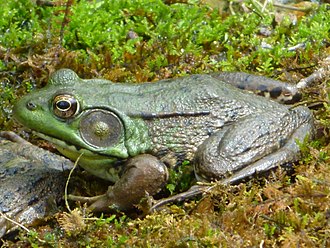
The gray treefrog (Dryophytes versicolor) is a species of small arboreal frog in the family Hylidae. The species is native to much of the eastern United States and southeastern Canada. It is sometimes referred to as the eastern gray treefrog, northern gray treefrog, common gray treefrog, or tetraploid gray treefrog to distinguish it from its more southern, genetically distinct relative, Cope's gray treefrog.
As the specific name versicolor implies, the gray treefrog is variable in color. This ability to vary its color provides it with the ability to camouflage itself from gray to green or brown, depending on the environment around it. Dryophytes versicolor can change from nearly black to nearly white. It changes color at a slower rate than a chameleon. A unique aspect of the appearance of the gray treefrog is that its legs feature a dark band-like pattern which then contrast sharply with the black-marked bright yellow or orange under the sides of its legs and arms. Dead gray treefrogs and ones in unnatural surroundings are predominantly gray. The female does not call; however, the male does call. The female gray treefrog is usually larger than its male counterpart... Wikipedia →
Recent sightings of Gray Treefrog Species Complex in Isle Royale National Park
LIVEiNaturalistClosest Relatives at Isle Royale National Park




Global Distribution
Warmer areas are where this animal is recorded most often.
Parks Where Found
| # | Park | Country | Daily sighting probability |
|---|---|---|---|
| 1 | Shenandoah National Park | 🇺🇸 United States | |
| 2 | Acadia National Park | 🇺🇸 United States | |
| 3 | Isle Royale National Park | 🇺🇸 United States |