



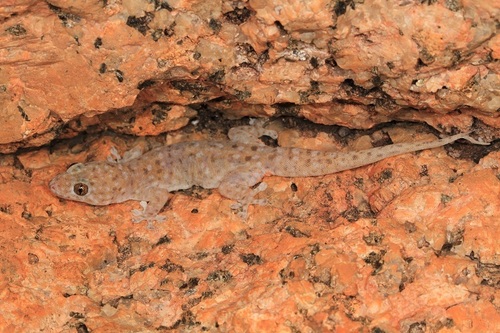
House Gecko
Gehyra australis
Silhouette: Gopal Murali · PhyloPic
- KingdomAnimalia (Animals)
- PhylumChordata (Chordates)
- ClassSquamata
- FamilyGekkonidae (Typical Geckos)
- GenusGehyra (Dtellas)
- SpeciesGehyra australis (House Gecko)
About the House Gecko
Gehyra australis, the Australian house gecko, northern dtella or top-end dtella, is a species of gecko native to northern and eastern Australia. It is also widespread in Indonesia, alongside common house geckos and four-clawed geckos.
Gehyra australis is primarily an arboreal gecko inhabiting woodlands and coastal and riverine forests. It can also occur near human dwellings and gardens. It is oviparous. In 2020, as a result of molecular genetic analysis, three new species were proposed for lineages of the Gehyra australis species complex: G. arnhemica (east Arnhem Land), G. gemina (northern deserts), and G. lauta (gulf, NT–Qld border). Names for the new species were registered in Zoobank. Under this definition, the range of G. australis sensu stricto is limited to the western Top End region of the Northern Territory, from Darwin surrounds to Port Essington, and Gregory National Park To Eva Valley at the edge of the Arnhem Plateau.
Members of the australis species complex are generally arboreal, and tend to be smaller than the rock-dwelling (saxicolous) koira group, though G. lauta is larger-bodied. G. chimera is adapted to an arboreal lifestyle: it had previously... Wikipedia →
Recent sightings of House Gecko in Kakadu National Park
LIVEiNaturalist



Global Distribution
Warmer areas are where this animal is recorded most often.
Parks Where Found
| # | Park | Country | Daily sighting probability |
|---|---|---|---|
| 1 | Kakadu National Park | 🇦🇺 Australia | |
| 2 | Litchfield National Park | 🇦🇺 Australia | |
| 3 | Nitmiluk National Park | 🇦🇺 Australia |
Quick answers
What are the chances of seeing a House Gecko in Kakadu National Park?
About 20% of wildlife watchers report a House Gecko sighting in Kakadu National Park, based on 18 verified sightings from GBIF citizen-science data.
When is the best time to see House Gecko in Kakadu National Park?
December has the highest sighting rate for House Gecko in Kakadu National Park in our monthly data.