


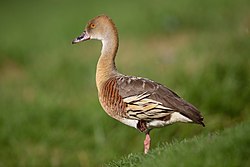


Plumed Whistling Duck
Dendrocygna eytoni
Silhouette: Sheatherius · PhyloPic
- KingdomAnimalia (Animals)
- PhylumChordata (Chordates)
- ClassAves (Birds)
- OrderAnseriformes (Waterfowl)
- FamilyAnatidae (Ducks, Geese, and Swans)
- GenusDendrocygna (Whistling-Ducks)
- SpeciesDendrocygna eytoni (Plumed Whistling Duck)
About the Plumed Whistling Duck
The plumed whistling duck (Dendrocygna eytoni), also called the grass whistling duck, is a species of bird in the whistling duck subfamily of the family Anatidae. It is resident and breeds in Australia, in a broad arc covering the northern half and most of the eastern third of the continent. There are also non-breeding and seasonally uncertain populations in New Zealand, the Solomon Islands, Indonesia and Papua New Guinea. It is a predominantly brown-coloured duck with a long neck and characteristic plumes arising from its flanks. The sexes are similar in appearance.
Described by English naturalist Thomas Campbell Eyton in 1838, its specific epithet honours its namer. Its generic name is derived from the Ancient Greek terms dendron "tree", and kuknos (via Latin cygnus) "swan". Alternate common names include; Eyton's plumed, red-legged or whistling tree-duck, and grey or red-legged whistler.
Measuring 42–60 cm (16.5–23.5 in) and weighing around one kilogram (2.2 lb), it is a long-necked duck with brown upperparts, paler underparts and a white rump. The chest is a chestnut colour with thin black bars, while long black-margined plumes arise from its flanks... Wikipedia →
Recent sightings of Plumed Whistling Duck in Kakadu National Park
LIVEiNaturalistClosest Relatives at Kakadu National Park

 Wandering Whistling Duck
Dendrocygna arcuata

Raja Shelduck
Radjah radjah

Green Pygmy-Goose
Nettapus pulchellus

Pacific Black Duck
Anas superciliosa

Grey Teal
Anas gracilis

 Australian Wood Duck
Chenonetta jubata

 White-eyed Duck
Aythya australis

Pink-eared Duck
Malacorhynchus membranaceus

 Magpie Goose
Anseranas semipalmata
Global Distribution
Warmer areas are where this animal is recorded most often.
Parks Where Found
| # | Park | Country | Daily sighting probability |
|---|---|---|---|
| 1 | Kakadu National Park | 🇦🇺 Australia | |
| 2 | Litchfield National Park | 🇦🇺 Australia | |
| 3 | Daintree National Park | 🇦🇺 Australia | |
| 4 | Nitmiluk National Park | 🇦🇺 Australia | |
| 5 | Springbrook National Park | 🇦🇺 Australia | |
| 6 | Blue Mountains National Park | 🇦🇺 Australia | |
| 7 | Abel Tasman National Park | 🇳🇿 New Zealand | |
| 8 | Grampians National Park | 🇦🇺 Australia | |
| 9 | Lamington National Park | 🇦🇺 Australia | |
| 10 | Royal National Park | 🇦🇺 Australia |
Quick answers
What are the chances of seeing a Plumed Whistling Duck in Kakadu National Park?
About 40% of wildlife watchers report a Plumed Whistling Duck sighting in Kakadu National Park, based on 877 verified sightings from GBIF citizen-science data.
When is the best time to see Plumed Whistling Duck in Kakadu National Park?
November has the highest sighting rate for Plumed Whistling Duck in Kakadu National Park in our monthly data.