



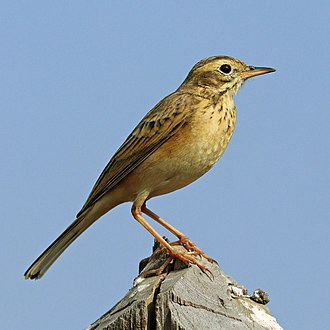
Rosy Pipit
Anthus roseatus
Silhouette: Susan Murphy (original photograph), T. Michael Keesey (vectorization) · PhyloPic
- KingdomAnimalia (Animals)
- PhylumChordata (Chordates)
- ClassAves (Birds)
- OrderPasseriformes (Perching Birds)
- FamilyMotacillidae (Wagtails and Pipits)
- GenusAnthus (Pipits)
- SpeciesAnthus roseatus (Rosy Pipit)
About the Rosy Pipit
The Rosy pipit (Anthus roseatus) is a species of bird in the family Motacillidae. It is found in Afghanistan, Bangladesh, Bhutan, China, India, South Korea, Myanmar, Nepal, Pakistan, Thailand and Vietnam. Birdlife International (English WIkipedia) Wikipedia →
Recent sightings of Rosy Pipit in Kaziranga National Park
LIVEiNaturalistClosest Relatives at Kaziranga National Park
 Oriental Pipit
Anthus rufulus

 Olive-backed Pipit
Anthus hodgsoni

Richard's Pipit
Anthus richardi

Blyth's Pipit
Anthus godlewskii

 White Wagtail
Motacilla alba

Citrine Wagtail
Motacilla citreola

Eastern Yellow Wagtail
Motacilla tschutschensis

Grey Wagtail
Motacilla cinerea

White-browed Wagtail
Motacilla maderaspatensis

 Forest Wagtail
Dendronanthus indicus

 Jungle Myna
Acridotheres fuscus

 Indian Pied Starling
Gracupica contra
Global Distribution
Warmer areas are where this animal is recorded most often.
Parks Where Found
| # | Park | Country | Daily sighting probability |
|---|---|---|---|
| 1 | Kaziranga National Park | 🇮🇳 India | |
| 2 | Langtang National Park | 🇳🇵 Nepal | |
| 3 | Chitwan National Park | 🇳🇵 Nepal | |
| 4 | Jiuzhaigou National Park | 🇨🇳 China | |
| 5 | Khangchendzonga National Park | 🇮🇳 India | |
| 6 | Manas National Park | 🇮🇳 India | |
| 7 | Royal Manas National Park | 🇧🇹 Bhutan | |
| 8 | Jim Corbett National Park | 🇮🇳 India | |
| 9 | Namdapha National Park | 🇮🇳 India | |
| 10 | Keoladeo National Park | 🇮🇳 India | |
| 11 | Gobi Gurvansaikhan National Park | 🇲🇳 Mongolia | |
| 12 | Royal Bardia National Park | 🇳🇵 Nepal |
Quick answers
What are the chances of seeing a Rosy Pipit in Kaziranga National Park?
About 20% of wildlife watchers report a Rosy Pipit sighting in Kaziranga National Park, based on 543 verified sightings from GBIF citizen-science data.
When is the best time to see Rosy Pipit in Kaziranga National Park?
April has the highest sighting rate for Rosy Pipit in Kaziranga National Park in our monthly data.