
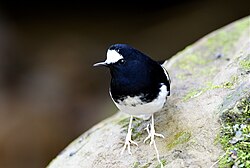



Little Forktail
Enicurus scouleri
Silhouette: Andy Wilson · PhyloPic
- KingdomAnimalia (Animals)
- PhylumChordata (Chordates)
- ClassAves (Birds)
- OrderPasseriformes (Perching Birds)
- FamilyMuscicapidae (Old World Flycatchers, Robins, and Chats)
- GenusEnicurus (Forktails)
- SpeciesEnicurus scouleri (Little Forktail)
About the Little Forktail
The little forktail (Enicurus scouleri) is a species of bird in the family Muscicapidae. The specific name commemorates Dr. John Scouler of Glasgow. The sexes are alike, with black and white plumage. Black above, with white forehead; white band in wings extends across lower back, small, black rump patch; slightly forked, short tail with white in outer feathers; black throat, white below.
The little forktail is a bird of mountain streams, waterfalls and small shaded forest puddles; breeding between 1200-3700m. It is found in the Tian Shan and Himalayan mountain ranges, southern China and Taiwan. Its natural habitats are subtropical or tropical moist lowland forest and subtropical or tropical moist montane forest.
They are either solitary or found in pairs. They forage energetically on moss-covered and wet slippery rocks. Their diet consists primarily of aquatic insects, and they plunge underwater to pursue prey. It constantly wags and flicks its tail, occasionally launching short sallies. They are generally silent, save for a rarely uttered sharp 'TZitTzit' call. Wikipedia →
Recent sightings of Little Forktail in Khangchendzonga National Park
LIVEiNaturalistClosest Relatives at Khangchendzonga National Park

 Spotted Forktail
Enicurus maculatus

Slaty-backed Forktail
Enicurus schistaceus

Black-backed Forktail
Enicurus immaculatus

 Blue Whistling-Thrush
Myophonus caeruleus

Verditer Flycatcher
Eumyias thalassinus

Plumbeous Water Redstart
Phoenicurus fuliginosus

Blue-fronted Redstart
Phoenicurus frontalis

 Rufous-gorgeted Flycatcher
Ficedula strophiata

Large Niltava
Niltava grandis

White-capped Redstart
Chaimarrornis leucocephalus

Small Niltava
Niltava macgrigoriae

Little Pied Flycatcher
Ficedula westermanni
Global Distribution
Warmer areas are where this animal is recorded most often.
Parks Where Found
| # | Park | Country | Daily sighting probability |
|---|---|---|---|
| 1 | Namdapha National Park | 🇮🇳 India | |
| 2 | Khangchendzonga National Park | 🇮🇳 India | |
| 3 | Langtang National Park | 🇳🇵 Nepal | |
| 4 | Royal Manas National Park | 🇧🇹 Bhutan | |
| 5 | Taroko National Park | 🇹🇼 Taiwan | |
| 6 | Jim Corbett National Park | 🇮🇳 India | |
| 7 | Jiuzhaigou National Park | 🇨🇳 China | |
| 8 | Chitwan National Park | 🇳🇵 Nepal |
Quick answers
What are the chances of seeing a Little Forktail in Khangchendzonga National Park?
About 10% of wildlife watchers report a Little Forktail sighting in Khangchendzonga National Park, based on 27 verified sightings from GBIF citizen-science data.
When is the best time to see Little Forktail in Khangchendzonga National Park?
November has the highest sighting rate for Little Forktail in Khangchendzonga National Park in our monthly data.