


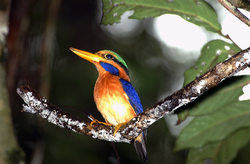

Rufous-collared Kingfisher
Actenoides concretus
Silhouette: Steven Traver · PhyloPic
- KingdomAnimalia (Animals)
- PhylumChordata (Chordates)
- ClassAves (Birds)
- OrderCoraciiformes (Rollers, Kingfishers, and Allies)
- FamilyAlcedinidae (Kingfishers)
- GenusActenoides (Wood Kingfishers)
- SpeciesActenoides concretus (Rufous-collared Kingfisher)
About the Rufous-collared Kingfisher
The rufous-collared kingfisher (Actenoides concretus) is a species of bird in the family Alcedinidae. It is found in Brunei, Indonesia, Malaysia, Myanmar, and Thailand. Its natural habitats are subtropical or tropical moist lowland forest and subtropical or tropical moist montane forest.
It is threatened by habitat loss. This species is 22–25.5 cm (8.7-10.0 inches) long and about 60-90 grams (2.1-3.2 ounces), making it medium-sized among kingfishers. It is mostly blue-green above, with yellow spots on its back. It has a green crown and a black eye mask.
Despite its name, some do not have the rufous breast band. Instead, those individuals have rufous underparts overall. Wikipedia →
Recent sightings of Rufous-collared Kingfisher in Khao Luang National Park
LIVEiNaturalistClosest Relatives at Khao Luang National Park

 Banded Kingfisher
Lacedo pulchella

 White-throated Kingfisher
Halcyon smyrnensis

Black-capped Kingfisher
Halcyon pileata

 Black-backed Dwarf-Kingfisher
Ceyx erithaca

Blue-eared Kingfisher
Alcedo meninting

Blue-banded Kingfisher
Alcedo euryzona

Common Kingfisher
Alcedo atthis

 Red-bearded Bee-eater
Nyctyornis amictus

 Dollarbird
Eurystomus orientalis

Indochinese Roller
Coracias affinis

Blue-throated Bee-eater
Merops viridis

Blue-tailed Bee-eater
Merops philippinus
Global Distribution
Warmer areas are where this animal is recorded most often.
Parks Where Found
| # | Park | Country | Daily sighting probability |
|---|---|---|---|
| 1 | Way Kambas National Park | 🇮🇩 Indonesia | |
| 2 | Khao Luang National Park | 🇹🇭 Thailand | |
| 3 | Sepilok | 🇲🇾 Malaysia | |
| 4 | Khao Sok National Park | 🇹🇭 Thailand | |
| 5 | Taman Negara National Park | 🇲🇾 Malaysia | |
| 6 | Danum Valley Conservation Area | 🇲🇾 Malaysia | |
| 7 | Kinabalu Park | 🇲🇾 Malaysia | |
| 8 | Kinabatangan Wildlife Sanctuary | 🇲🇾 Malaysia | |
| 9 | Kerinci Seblat National Park | 🇮🇩 Indonesia | |
| 10 | Bako National Park | 🇲🇾 Malaysia | |
| 11 | Gunung Leuser National Park | 🇮🇩 Indonesia |
Quick answers
What are the chances of seeing a Rufous-collared Kingfisher in Khao Luang National Park?
About 30% of wildlife watchers report a Rufous-collared Kingfisher sighting in Khao Luang National Park, based on 212 verified sightings from GBIF citizen-science data.
When is the best time to see Rufous-collared Kingfisher in Khao Luang National Park?
May has the highest sighting rate for Rufous-collared Kingfisher in Khao Luang National Park in our monthly data.