

African Pied Hornbill
Lophoceros fasciatus
Silhouette: Charles J. Sharp and T. Michael Keesey · PhyloPic
- KingdomAnimalia (Animals)
- PhylumChordata (Chordates)
- ClassAves (Birds)
- OrderBucerotiformes (Hornbills and Hoopoes)
- FamilyBucerotidae (Hornbills)
- GenusLophoceros (Whistling Hornbills)
- SpeciesLophoceros fasciatus (African Pied Hornbill)
About the African Pied Hornbill
The Congo pied hornbill (Lophoceros fasciatus) is a bird of the hornbill family, a family of tropical near-passerine birds found in the Old World. The Congo pied hornbill is native to the Congo Basin. This is a bird of mainly forest habitats. The female lays up to four white eggs in a tree hole, which is blocked off during incubation with a cement made of mud, droppings and fruit pulp. There is only one narrow aperture, just big enough for the male to transfer food to the mother and the chicks.
This is a large bird, 54 centimetres (21 in) in length. It has mainly black plumage, with white belly and tail tip. The long, curved black and yellow bill has a medium-sized casque. The sexes are similar, but the female has a smaller casque. Immature birds are duller, have a smaller bill, and no casque. The flight is undulating.
The Congo pied hornbill is omnivorous and eats fruit and insects. It feeds mainly in trees and is attracted to oil palms. This conspicuous and gregarious bird advertises its presence with its whistling pii-pii-pii-pii- call.
When the chicks and the female are too big to fit in the nest, the mother breaks out and rebuilds the wall. Then... Wikipedia →
Recent sightings of African Pied Hornbill in Kibale National Park
LIVEiNaturalistClosest Relatives at Kibale National Park

 Crowned Hornbill
Lophoceros alboterminatus

African Grey Hornbill
Lophoceros nasutus

Black-and-white-casqued Hornbill
Bycanistes subcylindricus

White-thighed Hornbill
Bycanistes albotibialis

Piping Hornbill
Bycanistes fistulator
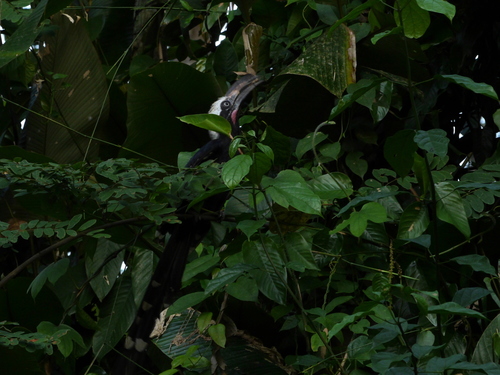
White-crested Hornbill
Horizocerus albocristatus

Black-casqued Hornbill
Ceratogymna atrata

 White-headed Wood Hoopoe
Phoeniculus bollei

 Northern Ground Hornbill
Bucorvus abyssinicus

 Common Hoopoe
Upupa epops

Green Wood Hoopoe
Phoeniculus purpureus
Forest Woodhoopoe
Phoeniculus castaneiceps
Global Distribution
Warmer areas are where this animal is recorded most often.
Parks Where Found
| # | Park | Country | Daily sighting probability |
|---|---|---|---|
| 1 | Semuliki National Park | 🇺🇬 Uganda | |
| 2 | Kibale National Park | 🇺🇬 Uganda | |
| 3 | Virunga National Park | 🇨🇩 Democratic Republic of the Congo | |
| 4 | Niokolo-Koba National Park | 🇸🇳 Senegal | |
| 5 | Murchison Falls National Park | 🇺🇬 Uganda | |
| 6 | Lake Mburo National Park | 🇺🇬 Uganda | |
| 7 | Bwindi Impenetrable National Park | 🇺🇬 Uganda |
Quick answers
What are the chances of seeing a African Pied Hornbill in Kibale National Park?
Under 5% of wildlife watchers report a African Pied Hornbill sighting in Kibale National Park, based on 9 verified sightings from GBIF citizen-science data.
When is the best time to see African Pied Hornbill in Kibale National Park?
June has the highest sighting rate for African Pied Hornbill in Kibale National Park in our monthly data.