

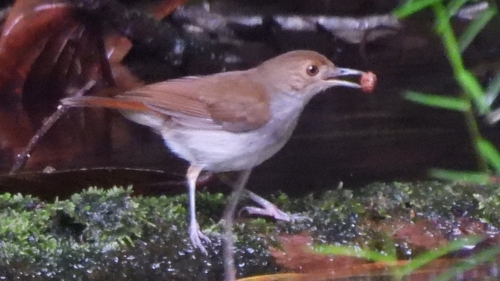
Sooty-capped Babbler
Malacopteron affine
Silhouette: Sheatherius · PhyloPic
- KingdomAnimalia (Animals)
- PhylumChordata (Chordates)
- ClassAves (Birds)
- OrderPasseriformes (Perching Birds)
- FamilyPellorneidae (Ground Babblers and Allies)
- GenusMalacopteron (Malacopteron Babblers)
- SpeciesMalacopteron affine (Sooty-capped Babbler)
About the Sooty-capped Babbler
The sooty-capped babbler (Malacopteron affine) is a member of the family Pellorneidae. It occurs in Malaysia, Indonesia, Brunei, Thailand, and Singapore. The sooty-capped babbler is also known in Malay as rimba tinjau belukar. Its main diet is small insects.
It is threatened by habitat loss. There are two subspecies: M. a. affine (Blyth, 1842) – Malay Peninsula, Sumatra, Banyak Islands, Bangka Islands M. a. phoeniceum Deignan, 1950 – Borneo Wikipedia →
Recent sightings of Sooty-capped Babbler in Kinabalu Park
LIVEiNaturalistClosest Relatives at Kinabalu Park

 Rufous-crowned Babbler
Malacopteron magnum

Moustached Babbler
Malacopteron magnirostre

Scaly-crowned Babbler
Malacopteron cinereum

 Temminck's Babbler
Pellorneum pyrrogenys

 Mountain Wren-Babbler
Napothera crassa

Black-throated Wren-Babbler
Napothera atrigularis

Brown Fulvetta
Alcippe brunneicauda
White-chested Babbler
Trichastoma rostratum

Black-capped Babbler
Pellorneum capistratum

Short-tailed Babbler
Pellorneum malaccense

Bornean Wren-Babbler
Ptilocichla leucogrammica

Ferruginous Babbler
Trichastoma bicolor
Global Distribution
Warmer areas are where this animal is recorded most often.
Parks Where Found
| # | Park | Country | Daily sighting probability |
|---|---|---|---|
| 1 | Danum Valley Conservation Area | 🇲🇾 Malaysia | |
| 2 | Taman Negara National Park | 🇲🇾 Malaysia | |
| 3 | Way Kambas National Park | 🇮🇩 Indonesia | |
| 4 | Kinabatangan Wildlife Sanctuary | 🇲🇾 Malaysia | |
| 5 | Gunung Leuser National Park | 🇮🇩 Indonesia | |
| 6 | Kinabalu Park | 🇲🇾 Malaysia | |
| 7 | Sepilok | 🇲🇾 Malaysia | |
| 8 | Kerinci Seblat National Park | 🇮🇩 Indonesia | |
| 9 | Tanjung Puting National Park | 🇮🇩 Indonesia | |
| 10 | Bako National Park | 🇲🇾 Malaysia |
Quick answers
What are the chances of seeing a Sooty-capped Babbler in Kinabalu Park?
Under 5% of wildlife watchers report a Sooty-capped Babbler sighting in Kinabalu Park, based on 31 verified sightings from GBIF citizen-science data.
When is the best time to see Sooty-capped Babbler in Kinabalu Park?
July has the highest sighting rate for Sooty-capped Babbler in Kinabalu Park in our monthly data.