
Pied Imperial Pigeon
Ducula bicolor
- KingdomAnimalia (Animals)
- PhylumChordata (Chordates)
- ClassAves (Birds)
- OrderColumbiformes (Pigeons and Doves)
- FamilyColumbidae (Pigeons and Doves)
- GenusDucula (Imperial Pigeons)
- SpeciesDucula bicolor (Pied Imperial Pigeon)
About the Pied Imperial Pigeon
The pied imperial pigeon (Ducula bicolor) is a relatively large, pied species of pigeon. It is found in forest, woodland, mangrove, plantations and scrub in Southeast Asia, ranging from Myanmar and Thailand, throughout Indonesia and east to the Philippines (where it is locally known as camasu and balud-puti) and the Bird's Head Peninsula in New Guinea. It is mainly found on small islands and in coastal regions. It remains locally common, and is therefore considered to be of least concern by BirdLife International and IUCN.
Its taxonomy is confusing and remains unsettled. It has sometimes included the Torresian, yellowish and silver-tipped imperial pigeons as subspecies. The widespread nominate subspecies of the pied imperial pigeon differs from all these by its plain white thighs and undertail coverts (though often with a dark spot at the very tip), and its narrowly dark-tipped bluish bill. For comparison, the other species' have black-spotted undertail coverts and thighs (spotting mainly near thighs in silver-tipped imperial pigeon), the bill of the Torresian imperial pigeon is greenish-yellow, and the bills of the yellowish and silver-tipped imperial pigeons are bluish... Wikipedia →
Closest Relatives at Komodo National Park

Green Imperial-Pigeon
Ducula aenea

Barred Dove
Geopelia maugeus

Spotted Dove
Spilopelia chinensis

Island Collared Dove
Streptopelia bitorquata

Asian Emerald Dove
Chalcophaps indica

Barred Cuckoo-Dove
Macropygia unchall
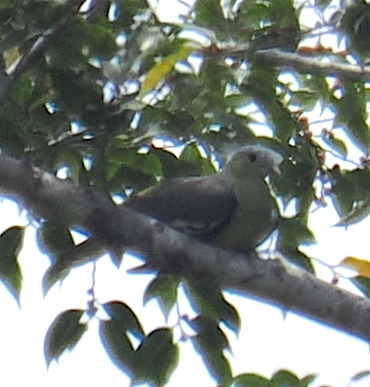
Flores Green-Pigeon
Treron floris

Ruddy Cuckoo-Dove
Macropygia emiliana

Black-naped Fruit-Dove
Ptilinopus melanospilus

Pink-necked Green-Pigeon
Treron vernans
Global Distribution
Where this species is recorded worldwide. Restricted to human observations from 2019 onwards — the same kind of record and the same period the probabilities on this page are built from, so collar-tracking studies, camera-trap arrays and museum specimens are excluded. Around Santa Rosa that removes 5,924 GPS fixes from a handful of tagged jaguars.
where this species is recorded (GBIF density — it tracks where observers go, not how likely a sighting is) · parks where it occurs — tap a pin for the sighting probability there
Parks Where Found
| # | Park | Country | Daily sighting probability |
|---|---|---|---|
| 1 | Raja Ampat | 🇮🇩 Indonesia | |
| 2 | Tangkoko Nature Reserve | 🇮🇩 Indonesia | |
| 3 | Tanjung Puting National Park | 🇮🇩 Indonesia | |
| 4 | Bali Barat National Park | 🇮🇩 Indonesia | |
| 5 | Kinabatangan Wildlife Sanctuary | 🇲🇾 Malaysia | |
| 6 | Danum Valley Conservation Area | 🇲🇾 Malaysia | |
| 7 | Sepilok | 🇲🇾 Malaysia |
Quick answers
What are the chances of seeing a Pied Imperial Pigeon in Komodo National Park?
About 40% of wildlife watchers report a Pied Imperial Pigeon sighting in Komodo National Park, based on 116 verified sightings from GBIF citizen-science data.
When is the best time to see Pied Imperial Pigeon in Komodo National Park?
April has the highest sighting rate for Pied Imperial Pigeon in Komodo National Park in our monthly data.