


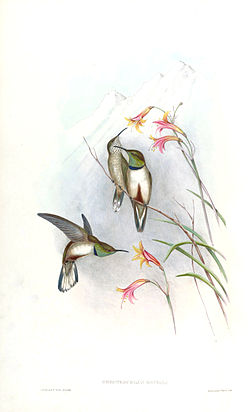


Andean Hillstar
Oreotrochilus estella
Silhouette: Ferran Sayol · PhyloPic
- KingdomAnimalia (Animals)
- PhylumChordata (Chordates)
- ClassAves (Birds)
- OrderApodiformes (Swifts and Hummingbirds)
- FamilyTrochilidae (Hummingbirds)
- GenusOreotrochilus (Typical Hillstars)
- SpeciesOreotrochilus estella (Andean Hillstar)
About the Andean Hillstar
The Andean hillstar (Oreotrochilus estella) is a species of hummingbird in the "coquettes", tribe Lesbiini of subfamily Lesbiinae. It is found in Argentina, Bolivia, Chile, and Peru. The Andean hillstar as known in 2022 has two subspecies, the nominate O. e. estella and O. e. bolivianus. Subspecies bolivianus has been variously treated as a separate species and as indistinguishable from the nominate and therefore not a subspecies; these treatments have not been accepted by current taxomomies. Until 2019 what is now the green-headed hillstar (O. stolzmanni) was considered a third subspecies of the Andean. The white-sided hillstar (O. leucopleurus) has been suggested as another subspecies of the Andean rather than a full species but that treatment has also not been accepted.
The Andean hillstar is 13 to 15 cm (5.1 to 5.9 in) long. Males weigh about 8.8 g (0.31 oz) and females about 8.0 g (0.28 oz). Adults have a medium length slightly decurved black bill. The adult male of the nominate subspecies has drab brown upperparts. It has a shiny green gorget with a black border that separates it from the white breast and belly. The belly has a... Wikipedia →
Recent sightings of Andean Hillstar in Lauca National Park
LIVEiNaturalist


Global Distribution
Warmer areas are where this animal is recorded most often.
Parks Where Found
| # | Park | Country | Daily sighting probability |
|---|---|---|---|
| 1 | Lauca National Park | 🇨🇱 Chile |
More parks will be added in future updates.
Quick answers
What are the chances of seeing a Andean Hillstar in Lauca National Park?
About 70% of wildlife watchers report a Andean Hillstar sighting in Lauca National Park, based on 863 verified sightings from GBIF citizen-science data.
When is the best time to see Andean Hillstar in Lauca National Park?
November has the highest sighting rate for Andean Hillstar in Lauca National Park in our monthly data.