



Crimson Finch
Neochmia phaeton
Silhouette: Sheatherius · PhyloPic
- KingdomAnimalia (Animals)
- PhylumChordata (Chordates)
- ClassAves (Birds)
- OrderPasseriformes (Perching Birds)
- FamilyEstrildidae (Waxbills and Allies)
- GenusNeochmia
- SpeciesNeochmia phaeton (Crimson Finch)
About the Crimson Finch
The crimson finch (Neochmia phaeton) is a species of bird in the family Estrildidae. It is found throughout Northern Australia as well as parts of southern New Guinea. Crimson finches feature a distinctively bright crimson coat and are known for their aggression.
Hombron and Jacquinot first observed crimson finches at Raffles Bay in northern Australia in 1841. Its protonym is Fringilla phaeton. "Crimson finch" has been designated as the official common name for the species by the International Ornithologists' Union (IOC). Alternate names include "blood finch" and "killer finch", derived from its tendency for aggressive behavior towards other red birds.
The crimson finch belongs to the family Estrildidae. Two subspecies are recognised: the black-bellied crimson finch (Neochmia p. phaeton) and its white-bellied counterpart (Neochmia p. evangelinae). A related species is the star finch (Neochmia ruficauda). It also bears resemblance to birds of the genus Lagonosticta (firefinches), to which it is closely related. Common physical characteristics between crimson finches and firefinches include a red head and bright crimson coat.
The crimson... Wikipedia →
Recent sightings of Crimson Finch in Litchfield National Park
LIVEiNaturalistClosest Relatives at Litchfield National Park

 Double-barred Finch
Taeniopygia bichenovii

 Chestnut-breasted Munia
Lonchura castaneothorax

 Masked Finch
Poephila personata

Long-tailed Finch
Poephila acuticauda
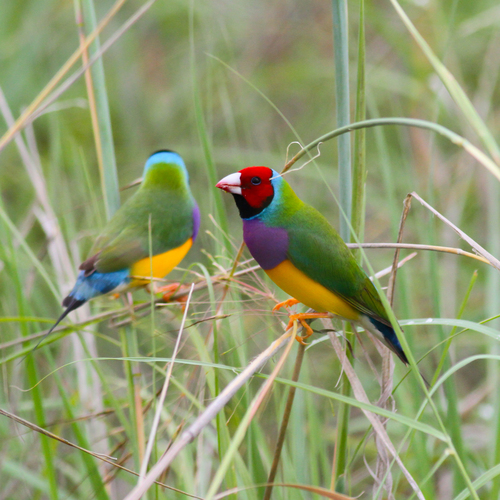
Gouldian Finch
Erythrura gouldiae

 Torresian Crow
Corvus orru

 White-bellied Cuckooshrike
Coracina papuensis

 Spangled Drongo
Dicrurus bracteatus

Varied Triller
Lalage leucomela

 Blue-faced Honeyeater
Entomyzon cyanotis

 Great Bowerbird
Chlamydera nuchalis

 Dusky Honeyeater
Myzomela obscura
Global Distribution
Warmer areas are where this animal is recorded most often.
Parks Where Found
| # | Park | Country | Daily sighting probability |
|---|---|---|---|
| 1 | Kakadu National Park | 🇦🇺 Australia | |
| 2 | Litchfield National Park | 🇦🇺 Australia | |
| 3 | Nitmiluk National Park | 🇦🇺 Australia | |
| 4 | Daintree National Park | 🇦🇺 Australia |
Quick answers
What are the chances of seeing a Crimson Finch in Litchfield National Park?
About 20% of wildlife watchers report a Crimson Finch sighting in Litchfield National Park, based on 58 verified sightings from GBIF citizen-science data.
When is the best time to see Crimson Finch in Litchfield National Park?
February has the highest sighting rate for Crimson Finch in Litchfield National Park in our monthly data.