
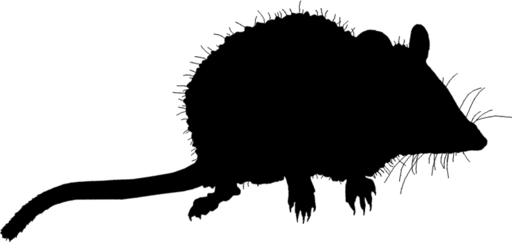
Pygmy Planigale
Planigale maculata
Silhouette: Robbi Bishop-Taylor · PhyloPic
- KingdomAnimalia (Animals)
- PhylumChordata (Chordates)
- ClassMammalia (Mammals)
- OrderDasyuromorphia (Carnivorous Marsupials)
- FamilyDasyuridae (Dasyurids)
- GenusPlanigale (Planigales)
- SpeciesPlanigale maculata (Pygmy Planigale)
About the Pygmy Planigale
The common planigale (Planigale maculata), also known as the pygmy planigale or coastal planigale, is one of the small carnivorous marsupials known as "marsupial mice" found in Australia. There they fill a similar niche to the insectivores of other parts of the world.
The common planigale was first described by John Gould in 1851, using a specimen forwarded to England by the collector Frederick Strange. It was originally described as Antechinus maculatus, and it was retained in the genus Antechinus until Mike Archer transferred it to Planigale in his 1976 revision of the latter genus. The species' scientific name means "spotted flat-weasel".
Two subspecies are recognised: P. m. maculata, found on mainland Australia; P. m. sinualis, found on Groote Eylandt. As a "marsupial mouse," the common planigale lies somewhere between a mouse and a shrew in shape. Its body is covered in fur, though that of the tail is sparse when compared to the rest of the body. The underside of its coat is a light grayish yellow color, while the rest varies by individual from gray to a cinnamon color. This species is the largest of the genus, with a body and head length of about 100... Wikipedia →
Recent sightings of Pygmy Planigale in Litchfield National Park
LIVEiNaturalistClosest Relatives at Litchfield National Park


Global Distribution
Warmer areas are where this animal is recorded most often.
Parks Where Found
| # | Park | Country | Daily sighting probability |
|---|---|---|---|
| 1 | Litchfield National Park | 🇦🇺 Australia | |
| 2 | Kakadu National Park | 🇦🇺 Australia |