

Bank Myna
Acridotheres ginginianus
- KingdomAnimalia (Animals)
- PhylumChordata (Chordates)
- ClassAves (Birds)
- OrderPasseriformes (Perching Birds)
- FamilySturnidae (Starlings)
- GenusAcridotheres (Typical Mynas)
- SpeciesAcridotheres ginginianus (Bank Myna)
About the Bank Myna
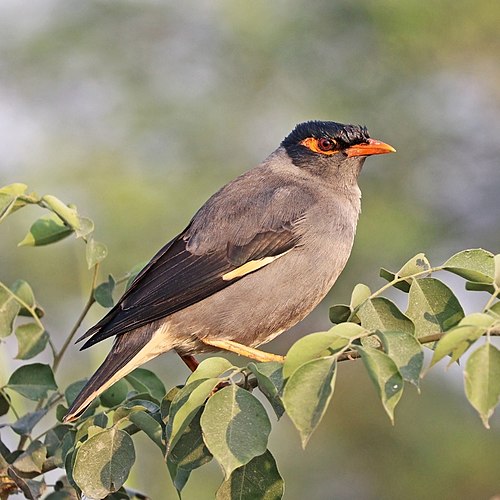
The bank myna (Acridotheres ginginianus) is a myna found in the northern parts of South Asia. It is smaller but similar in colouration to the common myna, only differing in having brick-red naked skin behind the eyes instead of yellow. It is greyer on the underside and in this and in the presence of a slight tuft of feathers bears some resemblance to the jungle myna. They are found in flocks on the plains of northern and central India, often within towns and cities. Their range appears to be extending southwards into India. The name is derived from their habit of nesting almost exclusively in the earthen banks of rivers, where they excavate burrows and breed in large colonies.
The head is black on the crown and sides and the upper plumage is slaty grey while the underside is lighter grey with pale pink plumage towards the centre of the abdomen. The wing is black but has a wing patch at the base of the primaries and the tips of the outer tail feathers are pale pinkish buff. The naked skin behind the eye is brick red, the legs are yellow while the iris is deep red. The sexes are indistinguishable in the field. Young birds have a browner head and neck.
The species is... Wikipedia →
Closest Relatives at Manas National Park

Jungle Myna
Acridotheres fuscus

White-vented Myna
Acridotheres grandis

Chestnut-tailed Starling
Sturnia malabarica

Indian Pied Starling
Gracupica contra

Common Hill Myna
Gracula religiosa

Brahminy Starling
Sturnia pagodarum

Spot-winged Starling
Saroglossa spiloptera

Black Drongo
Dicrurus macrocercus

Siberian Stonechat
Saxicola maurus

Red-whiskered Bulbul
Pycnonotus jocosus

Oriental Magpie-Robin
Copsychus saularis

Black-hooded Oriole
Oriolus xanthornus
Global Distribution
Where this species is recorded worldwide. Restricted to human observations from 2019 onwards — the same kind of record and the same period the probabilities on this page are built from, so collar-tracking studies, camera-trap arrays and museum specimens are excluded. Around Santa Rosa that removes 5,924 GPS fixes from a handful of tagged jaguars.
where this species is recorded (GBIF density — it tracks where observers go, not how likely a sighting is) · parks where it occurs — tap a pin for the sighting probability there
Parks Where Found
| # | Park | Country | Daily sighting probability |
|---|---|---|---|
| 1 | Keoladeo National Park | 🇮🇳 India | |
| 2 | Ranthambore National Park | 🇮🇳 India | |
| 3 | Kaziranga National Park | 🇮🇳 India | |
| 4 | Bandhavgarh National Park | 🇮🇳 India | |
| 5 | Royal Bardia National Park | 🇳🇵 Nepal | |
| 6 | Chitwan National Park | 🇳🇵 Nepal | |
| 7 | Jim Corbett National Park | 🇮🇳 India | |
| 8 | Sundarbans National Park | 🇮🇳 India | |
| 9 | Kanha National Park | 🇮🇳 India | |
| 10 | Gir National Park | 🇮🇳 India | |
| 11 | Satpura National Park | 🇮🇳 India | |
| 12 | Manas National Park | 🇮🇳 India |