


Brahminy Starling
Sturnia pagodarum
- KingdomAnimalia (Animals)
- PhylumChordata (Chordates)
- ClassAves (Birds)
- OrderPasseriformes (Perching Birds)
- FamilySturnidae (Starlings)
- GenusSturnia (Sturnia Starlings)
- SpeciesSturnia pagodarum (Brahminy Starling)
About the Brahminy Starling
The brahminy starling or brahminy myna (Sturnia pagodarum) is a member of the starling family of birds. It is usually seen in pairs or small flocks in open habitats on the plains of the Indian subcontinent. The brahminy starling was formally described in 1789 by the German naturalist Johann Friedrich Gmelin in his revised and expanded edition of Carl Linnaeus's Systema Naturae. He placed it with the thrushes in the genus Turdus and coined the binomial name Turdus pagodarum. The specific epithet pagodarum is Modern Latin meaning "of the temples" or "of the pagodas". Gmelin based his account on the "Le Martin Brame" that had been described in 1782 by the French naturalist Pierre Sonnerat in his book Voyage aux Indes orientales et à la Chine. Sonnerat mentioned that the bird was found on the Malabar and Coromandel Coasts of India.
The brahminy starling was formerly placed in the genus Sturnus. A molecular phylogenetic study published in 2008 found that the genus was polyphyletic. In the reoganization to create monotypic genera, the brahminy starling was one of five starlings moved to the resurrected genus Sturnia that had been introduced in 1837 by René Lesson. The species... Wikipedia →
Closest Relatives at Manas National Park

Chestnut-tailed Starling
Sturnia malabarica

Jungle Myna
Acridotheres fuscus

Indian Pied Starling
Gracupica contra

Common Hill Myna
Gracula religiosa

White-vented Myna
Acridotheres grandis

Spot-winged Starling
Saroglossa spiloptera
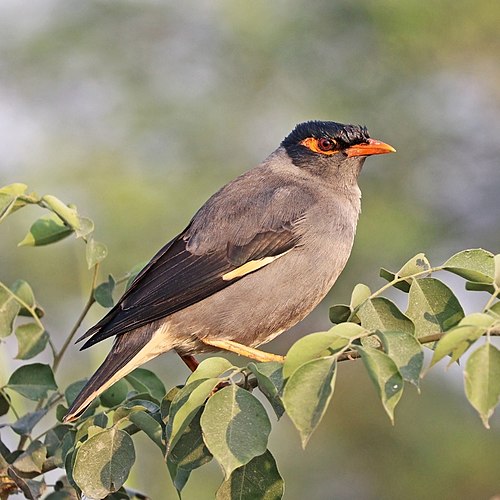
Bank Myna
Acridotheres ginginianus

Black Drongo
Dicrurus macrocercus

Siberian Stonechat
Saxicola maurus

Red-whiskered Bulbul
Pycnonotus jocosus

Oriental Magpie-Robin
Copsychus saularis

Black-hooded Oriole
Oriolus xanthornus
Global Distribution
Where this species is recorded worldwide. Restricted to human observations from 2019 onwards — the same kind of record and the same period the probabilities on this page are built from, so collar-tracking studies, camera-trap arrays and museum specimens are excluded. Around Santa Rosa that removes 5,924 GPS fixes from a handful of tagged jaguars.
where this species is recorded (GBIF density — it tracks where observers go, not how likely a sighting is) · parks where it occurs — tap a pin for the sighting probability there
Parks Where Found
| # | Park | Country | Daily sighting probability |
|---|---|---|---|
| 1 | Keoladeo National Park | 🇮🇳 India | |
| 2 | Mudumalai National Park | 🇮🇳 India | |
| 3 | Ranthambore National Park | 🇮🇳 India | |
| 4 | Bandhavgarh National Park | 🇮🇳 India | |
| 5 | Nagarhole National Park | 🇮🇳 India | |
| 6 | Gir National Park | 🇮🇳 India | |
| 7 | Bandipur National Park | 🇮🇳 India | |
| 8 | Satpura National Park | 🇮🇳 India | |
| 9 | Kanha National Park | 🇮🇳 India | |
| 10 | Jim Corbett National Park | 🇮🇳 India | |
| 11 | Yala National Park | 🇱🇰 Sri Lanka | |
| 12 | Royal Bardia National Park | 🇳🇵 Nepal | |
| 13 | Chitwan National Park | 🇳🇵 Nepal | |
| 14 | Sundarbans National Park | 🇮🇳 India | |
| 15 | Manas National Park | 🇮🇳 India | |
| 16 | Wilpattu National Park | 🇱🇰 Sri Lanka | |
| 17 | Periyar National Park | 🇮🇳 India | |
| 18 | Sinharaja Forest Reserve | 🇱🇰 Sri Lanka | |
| 19 | Doi Inthanon National Park | 🇹🇭 Thailand |