

Bell Glass Frog
Cochranella nola
Silhouette: Dmitry Bogdanov (vectorized by T. Michael Keesey) · PhyloPic
- KingdomAnimalia (Animals)
- PhylumChordata (Chordates)
- ClassAmphibia (Amphibians)
- OrderAnura (Frogs and Toads)
- FamilyCentrolenidae (Glass Frogs)
- GenusCochranella
- SpeciesCochranella nola (Bell Glass Frog)
About the Bell Glass Frog
Cochranella nola is a species of frog in the family Centrolenidae, the glass frogs, so named because of the transparent skin on the underside of the abdomen through which the internal organs can be seen. This species is endemic to Bolivia where it is found in the Andean foothills in the Santa Cruz Department. Its natural habitats are subtropical or tropical moist montane forests and rivers. The scientific name nola is Latin for "small bell", and refers to the high-pitched, bell-like call of the male in the breeding season.
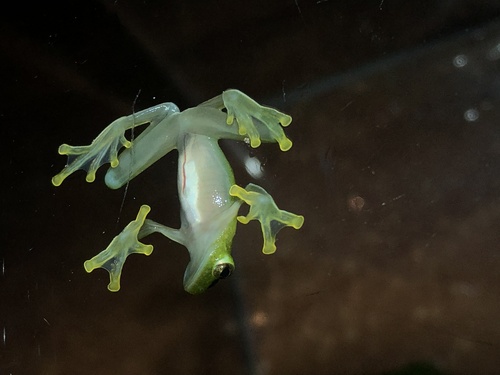
Cochranella nola is a small arboreal species of glass frog. Males are about 21 mm (0.8 in) long while females are a little larger at 25 mm (1.0 in). This frog has a truncated snout and vomerine teeth, widely-separated eyes and small, indistinct tympani. The dorsal surface and flanks are finely granulated while the hands and feet are smooth. The limbs are slender, the digits having adhesive toepads; there is extensive webbing between fingers III and IV, and between the toes. The dorsal surface and flanks of this frog are a uniform green with fine white speckling; the ventral surface is white, the hind part being transparent, enabling the yellow intestines... Wikipedia →
Recent sightings of Bell Glass Frog in Manu National Park
LIVEiNaturalistClosest Relatives at Manu National Park
 White-hearted Glass Frog
Hyalinobatrachium carlesvilai

 Santa Cecilia Glass Frog
Teratohyla midas

 Eastern Cane Toad
Rhinella marina

White-lined Leaf Frog
Phyllomedusa vaillantii

Amazon Sheep Frog
Hamptophryne boliviana

 Surinam Horned Frog
Ceratophrys cornuta

 Rocket Tree Frog
Boana lanciformis

Map Tree Frog
Boana geographica

Red Snouted Tree Frog
Scinax ruber

 Peru white-lipped frog
Leptodactylus rhodonotus

Madre de Dios Thin-toed Frog
Leptodactylus didymus

Rio Mamore Robber Frog
Pristimantis fenestratus
Global Distribution
Warmer areas are where this animal is recorded most often.
Parks Where Found
| # | Park | Country | Daily sighting probability |
|---|---|---|---|
| 1 | Manu National Park | 🇵🇪 Peru |
More parks will be added in future updates.